Compared with RPG Tsukuru 2#
This page is for a reader who knows RPG Tsukuru 2 (Super Famicom, 1996), or its PlayStation successor RPG Tsukuru 3, and wants to know what Super Dante does differently and where to find things in it. RPG Tsukuru 2 is "RT2" from here on; it has a guide of its own, and this page links its pages where they help.
RT2 is Super Dante rebuilt on the same core. The two cartridges come from the same studio, Kuusou Kagaku (Behind the scenes), and they run much of the same code: the start-up, the random numbers, the decompressor, the event interpreter's heart, the machine that runs every window, the Turbo File code and the sound formats. RT2 kept Super Dante's event model, its database kinds and its command window, and rewrote nearly everything else bigger: kanji, spell effects of your own choosing, more commands, a field you build yourself, the memory pack. It dropped what Super Dante had done its own way: items carried by each hero, a field drawn in mode 7, packed map parts and walls on the edges of cells.
Both programs have been taken apart to the byte, in this study and in RT2's, so what follows compares what the two programs do, not what their manuals say.
At a glance#
| Area | Super Dante (SFC, 1995) | RPG Tsukuru 2 (SFC, 1996) | What RT2 did |
|---|---|---|---|
| The core | Start-up, the main loop, interrupts, the random numbers, the decompressor, the object system | The same code, mostly a few bytes further on | Kept it whole; added a second graphics packer and a mode of its own for editing |
| Front end | Game, Edit, Turbo File; test play and delete-all in the Edit menu; a sample load in every editor | Game, Edit, Turbo File, Memory Pack; a Config and a Data page | Added the memory pack and the configuration page; moved delete-all and the sample load to one page |
| Save | 32 KB; one checksum over the whole game; three play slots of 256 bytes; a message when the save is erased | 64 KB; nine checksums, one a section; three bigger slots; erased without a word | Kept the shape; added room and per-section sums; dropped the message |
| Database | 8 heroes, 128 items in 14 kinds, 32 spells whose effect is fixed by their number, 80 enemies | 12 heroes, 127 items in 15 kinds, 64 spells each choosing one of 20 effects, 96 enemies | Added freely chosen spell effects and more of everything |
| Text | One byte a character; 16 kanji; a proportional font and one 8 × 8 font | The same kana and digits at the same codes; 96 typeable kanji on two pages; two 8 × 8 fonts | Kept the kana; added the kanji page; redrew the fonts |
| Events | 4 pages; conditions on an item, the party, a switch, gold; 53 commands; 200 switches; one event space of 17,772 bytes | The same page model; the same 53 commands and 22 more; 240 switches; a block per map, 43,960 bytes in all | Kept every command and the interpreter; added 22 commands; renumbered them |
| Maps | Packed parts; three map kinds; four fixed fields in mode 7; walls on the edges of cells | Parts in a table; five map types; a field you build, in mode 1; a cell is open or closed | Added a user-made field; dropped the packing, the mode 7 field and edge walls |
| Graphics | 54 characters of 16 × 16, 54 enemies, 9 battle backgrounds, 13 magic animations | 71 characters of 16 × 24, 83 enemies in four colours, 17 backgrounds, 23 animations | Kept the formats; added taller characters and more of everything |
| Battle | Damage attack − defence ÷ 2 (0 possible); the front hero hit more often; confusion does nothing; items always used up | (attack − defence) ÷ 2, at least 1; any hero equally; confused heroes attack at random; items break by chance; a treasure chest | Kept the frame (turn order, escape, experience); changed almost every rule inside |
| Play | Ten items a hero, with give and discard; Order in the command window; four-item shops; a title card on every new game; one fixed encounter curve; a ship and an airship | One shared bag; Settings; shops of up to 8 with comparisons; an encounter rate per area; three vehicles; curses and damaging floors | Kept the command window, inns, saving and game over; dropped per-hero items and the title card |
| Test play | B held: no battles, through walls | Invincibility, monsters on or off, a switch editor, the position, and B | Kept B; added the rest |
| Windows | Every window and editor page is a script for one small machine in the cartridge | The same machine, its codes rearranged | Kept it; recompiled the scripts |
| Sound | Its own driver with its own clock; 31 songs, 60 effects | A rewritten driver on the same formats; 30 songs, 65 effects; a memory pack's songs | Kept the formats; rewrote the code |
| Storage | A Turbo File Twin file of 32 blocks, numbered by the game; no memory pack | A Twin file of 62 blocks in named slots; the memory pack | Kept the Turbo File code (Super Dante's is the older build); added the pack |
| Sample game | FATE, a Norse-myth fantasy played straight | だんきちのバクチンだいさくせん!!, a school comedy that teaches the manual | Nothing carried over |
Area by area#
The program's core#
Compared byte for byte, the two ROMs share 412 runs of 32 bytes or more, about 47 KB. The start-up and interrupt code sit at the very same addresses in both, and the core library (the random numbers, multiplication and division, the decompressor, the objects, the windows and cursors) a few bytes apart. Further in, the two share the event interpreter's step, the routine that runs people's movement, the text drawing, the mode 7 tables and pieces of the battle. Not shared: the save check, the editors, the encounter check and the sound driver's code. Everything else in RT2 is new code on the same design. The details are on How it works.
The random numbers come from the same generator, so a reader of RT2's battle page already knows how Super Dante rolls its dice. One difference showed when the same battles were played in two emulators: RT2's idle loop draws a number every frame, while Super Dante, by every sign, draws none between battles.
Front end and editors#
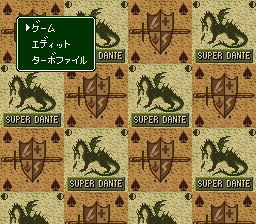
The title menu has Game, Edit and Turbo File, RT2's first three; there is no memory pack. Game holds the same three entries as RT2's: Continue, New Game and Game Data. RT2's New Game offers a test of the user game; Super Dante's has only the User Game and the Sample Game, and test play is an entry of the Edit menu (Getting started).
The Edit menu has ten entries, as RT2's has, but cut differently:
- Maps and events are one editor. Maps and Scenario マップシナリオのさくせい draws the maps, and its R menu opens Events イベントさくせい on the same map. RT2 has Map Making and Event Making side by side.
- Every editor's R menu has a Sample Load サンプルロード, which loads the sample game's version of that editor's data alone. RT2 loads the whole sample at once from its Data page.
- Delete All and Test Play are entries of the Edit menu. RT2 keeps delete-all on its Data page.
- There is no Config page: no choice of the editors' music, no mono switch, no cursor speed (RT2's Config).
The save#
Super Dante keeps one user game in 32 KB of battery memory, half of RT2's 64 KB. The shape is the same: a signature, three play slots (with the same three kinds of game, user, test and sample), the game, and a format when a check fails. The check itself is written afresh, and it differs in ways that matter to a player:
- One checksum covers the whole game. RT2 has nine, one a section. Either way a single bad byte erases everything; in Super Dante there is just no telling where it was.
- When the check fails, the title says so: バックアップのデータがきえました ("the backup data has been erased"). RT2 erases without a word.
- A play slot that fails its own check is cleared alone, as in RT2.
A play slot is 256 bytes and holds each of the eight heroes' level, HP, MP, experience and ten items, the party, the gold and 200 switches (The save and the Turbo File).
Database#
| Super Dante | RT2 | |
|---|---|---|
| Heroes | 8, four in the party | 12 |
| Hero stats | Five gains a level: strength, vitality, intelligence, agility, luck | The same five |
| Items | 128, in 14 kinds | 127, in 15 kinds |
| Who can equip | A mark for each of the 8 heroes | A mark for each of the 12 |
| Spells | 32; the effect is fixed by the spell's number | 64; each chooses one of 20 effects |
| Spell learning | Each hero's level for each of the 32 spells, on the Heroes page (Magic Level) | The same for 64 spells, in the hero's start settings |
| Enemies | 80: 32 of the field, 32 of the dungeons, 16 for events | 96: 32, 32 and 32 |
| Enemy colours | One palette each | A choice of four |
| Battle methods | 16 | 14 |
| Title | One title line and one name line | Two title lines and three credit lines |
| Start settings | Party, gold, a ship and an airship, seven music slots, the start place | Party, gold, three vehicles, music, the start place |
The biggest difference is in magic. A Super Dante spell's effect is fixed by its number: spell 0 heals one hero, spells 3 and 4 heal everyone, spell 5 teleports, spells 20–31 do damage, and so on through the 32 effects (The database). The editor lets you change a spell's name, MP cost, power and animation, not what it does. RT2 has twice the spells and lets each choose any of 20 effects (RT2's magic).
The heroes' page shows more at once than RT2's: the five gains a level, Magic Level まほうレベル (the level at which the hero learns each spell), and beside them the hero's strength at a chosen level, worked out as you type. The R menu's Type タイプ fills in the five gains from one of six presets (hero, warrior, mage, priest, sage, thief); the type itself isn't kept.
Items are kinds 0–13: two plain kinds (one that can't be discarded or sold, one that can), five of equipment, a key, MP and HP recovery, an antidote, a paralysis cure, a magic item that casts a spell, and an event item. Enemies have 16 battle methods to RT2's 14, among them self-destruct, revive and attack twice.
Text#
Super Dante writes one byte a character with no second page. The kana, the digits and A–O sit at the very codes RT2 uses; P–Z and the space sit elsewhere. There are 16 kanji, all typeable on the keyboard's Other page: 姫 王 城 塔 戦 死 黒 法 攻 撃 神 剣 街 魔 士 聖. RT2 has 96 typeable kanji on two pages, more for its own menus, and a few marks Super Dante lacks (♪, ♡, quotation marks, brackets, plus). With no kanji page, Super Dante's menus write 力 as the katakana カ: こうげきカ, ぼうぎょカ.
Messages are drawn in a proportional font, as in RT2, but the two fonts are drawn separately: no glyph is the same. Super Dante has one 8 × 8 font for the small text, RT2 two.
Events#
The event model is RT2's. An event has up to four pages; the game shows the highest page whose conditions all hold, page 1 being the fallback. A condition is one of four kinds, an item carried, heroes in the party, a switch on, gold at least so much, exactly RT2's. Choices, messages and the interpreter that runs them work as in RT2 (Events).
The commands are RT2's first 53, the same commands in RT2's order on the picker. RT2 then renumbered them in its saves and added 22 more codes: the caption, blinking and spinning, more screen colours, mosaic and a cure. Super Dante's picker shows each direction and each colour as its own entry, six pages of eight; RT2's folds them into 40 commands. The commands are compared one by one below.
What a maker will notice:
- The battle command has no music choice, and the ending command has none either: battles play the battle slot's song, the ending its own.
- A battle's four enemies are fought in number order, each once. An event set to 3, 3 and 1 fights enemies 1 and 3.
- A shop sells four items, not eight.
- Field events can't move: the editor refuses, and leaves the moves, the inn, the shop and the save point off the picker on the field.
- One event space for the whole game, 17,772 bytes, against RT2's 43,960 with 12,288 at most on one map. The Events editor shows the bytes left.
- 200 switches to RT2's 240, and no variables in either.
Maps and the field#
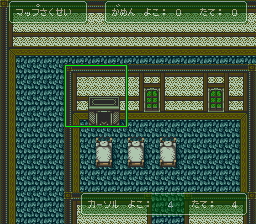
The units are RT2's: 16-pixel chips, parts of 4 × 4 chips, screens of 4 × 4 parts drawn from one pool that all 128 maps share, and maps of up to 4 × 4 screens. The pool holds 255 screens, against RT2's 300. Two layers, as in RT2: the ground, and an object layer drawn from object events (Maps).
Three things differ:
- The field is not yours to draw. Four fields are fixed in the ROM, drawn in mode 7, and a game chooses one with Change Field フィールドへんこう; you place events on it, nothing else. RT2's field is built from 184 island parts and kept in the save (RT2's field). RT2 kept mode 7 only for its air view.
- Three map types, castle, dungeon and town, each with its own tiles, colours and parts. RT2 has five.
- Walls sit on the edges of cells. A chip can close one side and leave the others open, so a counter or a fence can stand between two walkable cells. In RT2 a cell is passable or not (RT2's walking).
The enemy maps are painted per screen of the field and per pool screen of a map, and the editor shows the averages of the enemies chosen. The battle test sits in the enemy-map editor's R menu, as in RT2.
Graphics#
The formats are RT2's: enemies as tiles with a header, backgrounds as a tile set, magic as sprite frames played in a sequence. What changed is size and number: characters are 16 × 16 (RT2's are 16 × 24), 54 of them to RT2's 71; 54 enemies to 83, each enemy with its own palette where RT2 offers four colours; 9 battle backgrounds to 17; 13 magic animations, each with its own colours, to RT2's 23 sharing one set. The ship and the airship come in a few looks: a sailing ship or a small boat, and a dragon, an airship or a balloon (Graphics).
Battle#
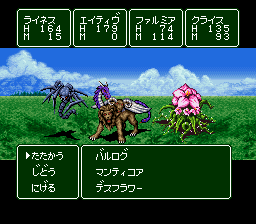
The battle has RT2's frame: the same random numbers, the same turn order by speed, the same rule that an enemy picks among its methods and spells with equal odds, the same escape roll (with its bug) and the same experience table. Almost every rule inside is Super Dante's own (How battles work):
| Super Dante | RT2 | |
|---|---|---|
| Damage | Attack − defence ÷ 2; 0 is possible | (attack − defence) ÷ 2, at least 1 |
| Critical hit | 1 in 16 (1 in 4 with Critical Up); attack − defence ÷ 4 | 1 in 16 (1 in 4 with the critical method); attack − defence |
| A random hero | Weighted: the front of the party is hit more often | Every living hero equally |
| Confused | Does nothing | Attacks a random hero or enemy |
| An enemy that revives | Every turn, no roll | 1 in 4, if dead at the round's start |
| Self-destruct | The enemy just dies: no damage, no reward | Damages the party, at half HP or less |
| Half miss | Attacks only | Attacks and every spell target |
| Poison in battle | None | 2 HP after the poisoned one's turn |
| Spells | 32, the effect fixed by the number | 64, each with one of 20 effects |
| Auto | The first heal, or the list's last attack spell (a bug) | Ranks spells and targets, no chance |
| Items | Always used up | Used up only when they break |
| Escape | Speed tests; and it always fails if no hero can act, always works if no enemy can | The same speed tests |
| Treasure chest | None | By the last enemy killed |
| Turn order, experience table, level-ups, enemies' equal odds, attack twice (a second choice and action), steal MP, retargeting | The same | The same |
The damage rule is worth a second look. Super Dante halves only the defence: attack 50 against defence 40 does 50 − 20 = 30, where RT2 would do (50 − 40) ÷ 2 = 5. Super Dante's numbers run high for that reason, and a hit that comes out at exactly 0 stays 0 (a result below 0 counts as 1, and a guarding target turns 0 into 1).
Play#
The field's command window is RT2's Dragon Quest window with one change: Order ならび stands where RT2 has Settings. There are no settings in play at all.
| Super Dante | RT2 | |
|---|---|---|
| Items | Ten per hero, no counts; Give and Discard; used up always | One bag of 127 kinds with counts; no discarding; a break chance |
| Command window | Order (ならび) in place of Settings; X talks, then searches | Settings (せってい) |
| Settings in play | None | Order, cursor speed, battle messages, sound, window colour |
| Unequip | Keeps the item | Loses it (a bug) |
| Reviving in the field | The spell can be cast, but only says the hero woke | Refused |
| Curses, damaging floors, the map item, calling a vehicle | None | All four |
| Shops | Up to 4 items; no stats shown and no equip check; equipped items can be sold | Up to 8, with the stats and who can equip; selling refuses some items |
| Inns | HP and MP restored, statuses kept; the price taken from part of the gold | The same, the same bug |
| Saving | On the field on foot, or at a save point; no overwrite question | On the field on foot, or at a save point |
| A new game | Opens on a title card: the title over the field | Opens straight on the game |
| Random battles | No rate: one fixed curve, 1 in 8 a step from the 16th | A rate of 0–8 per area |
| Enemy groups | 1–4 at random from the area's set, never the same enemy twice | Up to 4 set for each area, repeats allowed |
| Poison on the field | 2 HP a step (1 on a swamp); the swamp 1 | 1 HP a step; damaging floors |
| Walls | On the edges of cells: a side can be closed | A cell is passable or not |
| People's movement | 6 types (no treading on the spot, no blinking) | 8 types |
| Vehicles | A ship and an airship; the airship lands on grass, desert or shore | Land, sea and air; the air vehicle lands on grassland or snowfield |
| The ending | Nine cards of staff over the battle backgrounds, the game's author as SCENARIO | The game's three credit lines, then the staff and the copyrights |
| Back to the title | L + R + START + SELECT | The same |
The item rule changes the most. Each hero carries up to ten items of their own, equipment included; there is no shared bag and no counting. The Items command offers Use, Give and Discard, the shop asks which hero takes what you buy, and an Item + event gives the item to the first hero with room (Playing a game).
Every new game opens on a title card: the game's title over the field, with its own song, until a button is pressed (or about two minutes pass). A continued game skips it. RT2 has nothing like it.
Test play#
Super Dante's test play has one tool: hold B and no random battles start and the party walks through walls. RT2 kept that and added invincibility, monsters on or off, a switch editor and the party's position (RT2's test play). Both return to the title with L + R + START + SELECT.
Music and sound#
Super Dante has its own sound driver, the earlier generation of RT2's. The two use the same command bytes, the same tempo formula, the same pitch table and the same song records, so a Super Dante song would need only its header converted to play on RT2's driver; but the code was rewritten, and the two share only about 190 bytes beyond the pitch table. Super Dante's keeps its own clock, 62.5 ticks a second, where RT2's is ticked by the console every frame, and loads all its instruments and samples once at power-on. 31 songs and 60 effects, to RT2's 30 and 65; no songs from a memory pack (Music and sound).
Seven music slots choose the songs of play: battles, the ship, the airship, the field, towns, dungeons and castles. A slot set to 0 leaves those maps silent unless an event plays a song, which is how FATE's towns get their music.
Storage#
The Turbo File code is RT2's in an earlier build. A Super Dante file is 32 blocks, the whole save but its signature, play slots included, so three fit on a Twin (RT2's file is 62 blocks, two to a Twin). The game numbers its files itself, 000, 001 and on; RT2 names two slots. A damaged file is refused and kept, where RT2 deletes it. Super Dante's delete page lists every game on the Twin, RT2's too, and deletes their files as well (The save and the Turbo File).
There is no memory pack, and no Satellaview anything.
Menus and windows#
Every window, menu and editor page is a small program for the same script machine RT2 uses. Eight of its operations sit in swapped places between the two programs, so the scripts were compiled again for RT2, but the machine and the way the windows are built are one design (How it works).
Sample game#
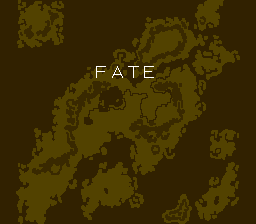
Nothing carried over. FATE is a Norse-myth fantasy played straight: ライネス, a holy sword, the world tree and its three roots, and a brother found at the end (The sample game). RT2's sample, だんきちのバクチンだいさくせん!!, is a school comedy whose lessons are the manual's tutorial, and ends by advertising RT3 (RT2's sample).
Hidden content#
Both carry the studio's development tag below the cartridge header, KUSOU KAGAKU DEVELOPMENT SYSTEM, Super Dante's at version 2.21 and RT2's at 2.28, and both use it to tell a reset from a power-on (in Super Dante read from the code, not run). The other leftovers differ. Super Dante has a debug box on its Turbo File pages that a player with a lost save would meet, an older build's crash screen and the scripts of a dropped "board / leave" command; RT2 has a test page left in its factory save (Behind the scenes).
Where things are#
For an RT2 user looking for something in Super Dante: first the menus and editors, then the event commands. RT2's names are those of RT2's guide.
| In RT2 | In Super Dante | Notes |
|---|---|---|
| Top menu → Memory Pack | — | No memory pack. The Turbo File is the only way off the cartridge. The save and the Turbo File |
| Game → Start → User Game Test | Edit → Test Play テストプレーのかいし | Test play is an Edit entry, with its own Continue and New Game. Getting started |
| Game → Start → Sample Game | Game → New Game → Sample Game サンプルゲーム | The same: played from the ROM, whatever the editors hold. The sample game |
| Edit → Data → delete everything | Edit → Delete All すべてのエディットデータさくじょ | An entry of the Edit menu |
| Edit → Data → load the whole sample | Each editor's R menu → Sample Load サンプルロード | One editor's data at a time. Getting started |
| Edit → Config (BGM, mono, cursor speed) | — | No configuration page |
| Map Making, Event Making | Edit → Maps and Scenario マップシナリオのさくせい, then R → Events イベントさくせい | Maps and events in one editor, on the same map. Maps, Events |
| The field editor (island parts) | Events → R → Change Field フィールドへんこう | Choose one of four fixed fields; you place events on it, nothing else. Maps |
| Hero Settings → vehicles, party, BGM | The start settings | Party, gold, the ship and the airship, the seven music slots and the start place. The database |
| Hero Settings → start settings → spell levels | Heroes → Magic Level まほうレベル | The level each of the 32 spells is learned at, on the hero's page |
| Magic Editing → effect | Magic: the spell's slot | Spell 0 is always Heal One 1, spell 31 Damage All B3. The database |
| Enemy Settings → colour | — | One palette for each enemy graphic |
| Enemy Map Editing → R → Battle Test | Enemy Maps → R → Battle Test せんとうテスト | The same place |
| Title Settings: two title lines, three credits | Title Settings: Title タイトル and Your Name あなたのなまえ | The name is the SCENARIO card of the ending |
| Command window → Settings | Command window → Order ならび | Party order only; nothing else can be set in play. Playing a game |
| The bag | Each hero's ten items | Items → a hero → Use, Give, Discard. Playing a game |
| Test play's Invincible, Monsters, Switches | — | Only B held: no battles, through walls |
| A memory pack's songs as BGM 31 and up | — | 31 songs, all in the ROM. Music and sound |
Event commands#
Super Dante's commands in the order of its picker, which is RT2's order, with RT2's counterparts. Super Dante's own names are explained on Events.
| Super Dante command | On screen | In RT2 | What differs |
|---|---|---|---|
| Message | ぶんしょうを かく | Message | The same: up to four lines a window |
| Switch on, Switch off | ゲームスイッチ ON, OFF | Switch on, off | 200 switches, numbered 0–199 (RT2: 240) |
| Item +, Item − | アイテムが ふえる, へる | Item +, − | The item goes to the first hero with room; with everyone full the player throws one away |
| Gold +, Gold − | おかねが ふえる, へる | Gold +, − | The same |
| Experience + | けいけんちが ふえる | Experience + | Adds experience to the party (Events on when levels come) |
| HP +, HP −, MP +, MP − | しゅじんこうの HP ふえる, へる; MP ふえる, へる | The same | The same commands |
| Poison, Paralyse | しゅじんこうに どくをかける, しゅじんこうを マヒ | Poison, Paralyse | No Cure command: RT2 added one |
| Hero joins, Hero leaves | しゅじんこうを くわえる, はずす | Hero joins, leaves | Eight heroes to choose from |
| Hero faces, Hero steps | しゅじんこう うえ / みぎ / した / ひだり むく, … いどう | Hero faces, moves | One command for each direction, as RT2 stores them; RT2's editor folds them into one |
| Event faces, Event steps | イベント うえ / みぎ / した / ひだり むく, … いどう | Event faces, moves | Not offered on the field, where events can't move. RT2 added blinking and spinning |
| Flash, Shake | がめん フラッシュ, がめん ゆらす | Flash, Shake | The same |
| Brighter, Darker, Red, Blue, Monochrome | がめん あかるく, くらく, あかく, あおく, モノクロに する | Screen colour | Five tints; RT2 has more, darkness and mosaic |
| Normal | がめん もとにもどす | Colour back | The same |
| Battle | てきと たたかう | Battle | No music choice; the four enemies are fought in number order, each once (3, 3, 1 fights 1 and 3) |
| Warp | ばしょ いどう | Warp | A map or the field, and a place |
| Inn | やどや | Inn | The same, 0–9,999 gold; not on the field |
| Shop | おみせ | Shop | Four items (RT2: eight); not on the field |
| Wait | ウェイト | Wait | The same, in tenths of a second |
| Vanish | イベント きえる | Event vanishes | The same |
| BGM, Sound | BGM へんこう, おとを ならす | BGM, Sound | 31 songs and 60 effects (RT2: 30 and 65) |
| Yes / no | はい / いいえ | Yes / no | The same: a branch for each answer |
| Save point | セーブ ポイント | Save point | Not on the field |
| Ending | エンディングに いく | Ending | No music choice: the ending always plays its own song |
| End of event | イベントしゅうりょう | End event | Alone on the picker's last page |
| — | — | Caption, Event blinks, Event spins, Cure, mosaic and more screen colours | RT2's 22 new codes |
What Super Dante has that RT2 doesn't#
- Items carried by each hero, with Give and Discard, and a shop that asks who takes the item.
- A title card on every new game, and an ending that puts the game's author on the SCENARIO card.
- Walls on the edges of cells, and a field in mode 7 under your feet as well as in the air.
- The hero's strength at any level, shown while you set the gains, and the type presets that fill them in.
- Three games on one Turbo File Twin, and a message when the cartridge's save is lost.
- Unequipping that keeps the item (RT2 loses it, a bug).
What an RT2 user will miss#
- Choosing what a spell does, and more than 32 of them; more than 8 heroes, 80 enemies or 200 switches.
- Kanji beyond 16, and ♪, quotation marks and brackets in messages.
- A field of your own; five map types; more than 255 screens.
- Captions, blinking and spinning events, mosaic, the extra screen colours and the cure command; a music choice for battles and the ending; shops of eight.
- Settings in play, encounter rates per area, enemy groups you set, curses, damaging floors, the land vehicle.
- Test play's invincibility, monster switch, switch editor and position.
- The memory pack, and songs made in Kanadeeru.
Before Super Dante: the PC line#
The title names ASCII's Dante, the RPG construction tool that came before the consoles. What follows is according to public sources; none of those programs was examined in this study.
| Title | Machine, year | What public sources say |
|---|---|---|
| Dante (RPGコンストラクションツール) | MSX2, early 1990 (one catalogue says December 1989) | From MSX Magazine's staff: a Dragon Quest-style maker with map switching, flags and the user's own graphics; 30 maps a disk; fixed music; a sample game, BADOMA |
| Dante 2 | MSX2, 1992 | A maker of action RPGs rather than a sequel |
| RPGツクール Dante98 | PC-9801, December 1992 | The first product called RPGツクール, a disk with a book. Its book gives field and dungeon maps, up to 4 events a place with up to 4 conditions (item, party member, switch, gold), 200 switches, 8 heroes in a party of 4, 128 items, 32 spells, about 160 enemies, and no variables |
| RPGツクール Dante98 II | PC-9801, July 1996 | Variables, loops and branches; after RPG Tsukuru 95 (1997) the PC line dropped the name Dante |
Read against the decoded cartridge, Super Dante is Dante98's design on the Super Famicom. The numbers Dante98's book publishes are the cartridge's own: 200 switches, 8 heroes in a party of 4, 128 items and 32 spells, and event conditions of the same four kinds, item, party member, switch and gold. RT2 then grew past every one of them (240 switches, 12 heroes, 64 spells).
Public sources also say FATE was ported from a Dante98 game, Fate ~The ancient relation~, with its events cut to fit the cartridge. That is one fan wiki's statement, not checked here; it would explain a sample far less tied to the product than RT2's.
Fan-made reference material, one of the Eschaton Games Tsukuru guides. Not affiliated with the publishers of the titles it covers. Corrections and questions: contact@eschaton.games.