Playing a game#
This chapter is the player's side of a Super Dante game: what the screen shows and what each command does. The same rules apply to the sample game FATE, to your own game and to a test run of it. How battles work gives the battle's rules in full. Events shows how a maker builds the shops, inns, doors and save points a player meets here.
Starting#
From the title menu, Game ゲーム → New Game はじめから begins a game, and Continue つづきから resumes a play save (Getting started).
Every new game opens on a title card: the game's title from Title Settings, over its field seen in Mode 7, with song 2 playing. Any button goes on; left alone, the card waits over two minutes. A continued game skips the card and puts the party back where it was saved.
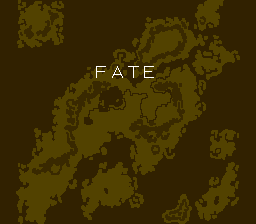
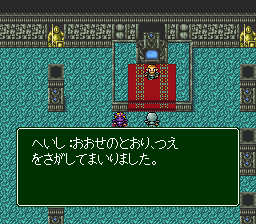
Then the party appears where the maker put it, carrying nothing (and, by the code, at full HP and MP). A game may begin with an event, as FATE does: its opening is a scene in a throne room, played out before the party sets off.
The field and the maps#
The party walks as a line: the leader first, the others following in its steps. The leader moves one cell in 8 frames, a little under 8 cells a second, and only in the four directions. Walking into something makes a dull thud and turns the leader to face it.
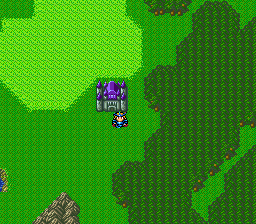
- The field is the world map: 256 × 256 cells, one of the four built into the ROM. It wraps around: walk off one side and you come in at the other.
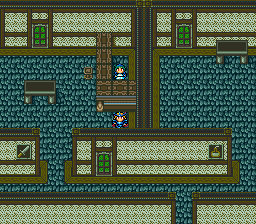
- A map (a castle, a town or a dungeon) is up to 64 × 64 cells, with edges. Each kind has its own look and its own music.
- A wall can block one side of a cell only. Super Dante decides passing by the edge, not by the cell: a cell can be open from the front and closed from behind. If the party stops where nothing seems to stand, that is why.
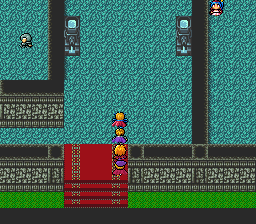
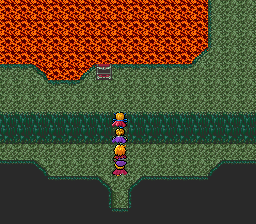
People in a map stand, wander, pace to and fro, or walk toward or away from the party, as their maker set them. Some events start when the party touches them or steps on them; others wait to be talked to or searched.
The command window#
Press A on the field to open the command window. Beside it, the gold is shown at the top right, and a box at the bottom shows each member's HP, MP and level (H, M, L). A poisoned or paralysed member shows どく or マヒ before the level, and a member below a quarter of their HP shows in yellow. The layout is Dragon Quest's.
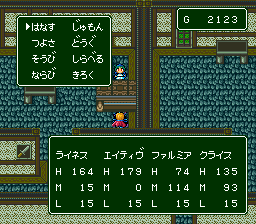 12345678910
- 1 Talk はなす the cell in front of the leader; X talks without the window
- 2 Spells じゅもん in the field only heal, teleport, revive and cure
- 3 Status つよさ level, HP, MP, equipment, attack, defence, the five stats, experience
- 4 Items どうぐ ten a hero: use, give or discard
- 5 Equip そうび five slots; unequipping keeps the item
- 6 Search しらべる underfoot first, then the cell in front
- 7 Order ならび the party's marching order
- 8 Record きろく save, on the field and on foot only
- 9 Gold G the party's gold
- 10 Party H M L HP, MP and level of each member; yellow below a quarter of the HP
| Command | Japanese | What it does |
|---|---|---|
| Talk | はなす | Speaks to whoever stands on the cell in front of the leader. Not from the ship |
| Spells | じゅもん | Casts a spell a hero has learned. In the field only heal, teleport, revive and cure |
| Status | つよさ | One hero in full: level, HP, MP, equipment, attack, defence, the five stats and experience |
| Items | どうぐ | A hero's ten carried items: Use つかう, Give わたす or Discard すてる |
| Equip | そうび | Changes a hero's weapon, armour, shield, helmet and ring |
| Search | しらべる | Looks at the cell underfoot, then the one in front. Not from the ship |
| Order | ならび | Puts the party in a new marching order |
| Record | きろく | Saves the game to one of three files: only on the field and on foot |
The window opens only when the leader stands squarely on a cell, and not in the air. Play stops while it is open.
Talk and Search#
Talk はなす reaches only the cell directly in front of the leader. The person there turns to face the party and speaks. If no one stands there, the game says so: そのほうこうには だれもいません, "there's nobody that way".
Search しらべる looks first at the cell the leader stands on, then at the one in front. Whatever a maker hid for searching is found this way. With nothing there, the answer is とくに かわったところは ありません: nothing unusual here.
X does both without the window: it talks to the cell in front, and if nobody answers, it searches, with no message either way. On the ship neither works: you can't talk or search here.
Status#
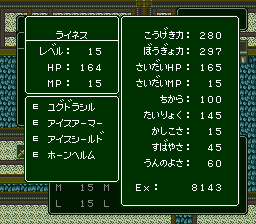
Status つよさ shows one hero in full: the level, HP and MP, the five pieces of equipment, Attack and Defence こうげきカ ぼうぎょカ, maximum HP and MP, the five stats (Strength, Vitality, Intelligence, Agility, Luck: ちから たいりょく かしこさ すばやさ うんのよさ) and experience (Ex). What the stats feed is on The database.
Items#
Each hero carries ten items. There is no shared bag and no counting: two potions take two of the ten places. Items どうぐ asks whose items, lists them (E marks what is equipped), and then asks what to do: Use つかう, Give わたす or Discard すてる.
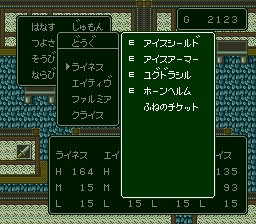
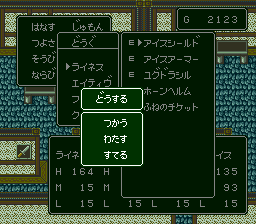
- Use: what happens depends on the item's kind (below). Healing items, cures and magic items are used up; the rest stay.
- Give hands the item to another hero, taking it off if it was equipped. A hero whose ten places are full can't take it: もちものが いっぱいで わたせない.
- Discard asks すててもいいですか? ("throw it away?") and drops it. Items marked × in the Items editor, and items with a price of 0, can't be thrown away: これは すてられません.
- A paralysed hero can't use, discard or equip, but can still give.
| Kind | Japanese | Used from Items in the field | Used up? |
|---|---|---|---|
| Plain items | × ○ | "But nothing happened." (× marks an item that can't be thrown away or sold) | No |
| Equipment | ぶき よろい たて かぶと ゆびわ | Nothing happens: equip it instead | No |
| Key | かぎ | Sets off an event in front of the party that starts "when a key is used" (by the code) | No |
| MP and HP recovery | MPかいふく HPかいふく | Restores the item's power in MP or HP, up to the maximum | Yes |
| Antidote | どくけし | Cures poison | Yes |
| Paralysis cure | マヒやく | Cures paralysis | Yes |
| Magic | まほう | Works its spell's field effect, with no MP spent (but see the bug below); a battle-only spell does nothing | Yes, unless nothing happened |
| Event | イベント | Nothing: an item for events to check | No |
When an event gives the party an item, it goes silently to the first member with a free place. If all are full, the game says so and asks which item to throw away to make room.
Equip#
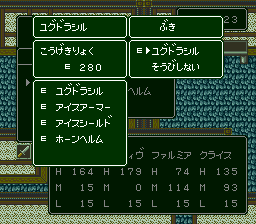
Equip そうび goes through the five slots in turn: weapon ぶき, armour よろい, shield たて, helmet かぶと and ring ゆびわ, then shows a summary. For each slot it lists the hero's own carried items of that kind, and Unequip そうびしない. An item the hero isn't allowed to wear answers そうびできない!? ("can't equip!?").
Unequipping keeps the item: it stays among the hero's ten, no longer marked E. There are no cursed items.
Spells#
Spells じゅもん asks who casts, then lists that hero's spells with their MP costs. In the field only the first eight spell slots work, because the effect belongs to the slot (The database):
- heal one (slots 0–2) and heal all (3–4) restore HP, up to the maximum;
- teleport (5) takes the party to a town or castle it has already reached, listed by the maps' names, four to a page (by the code; the study didn't try it);
- revive (6) only says めをさました ("woke up"), and spends the MP. No one stays fallen on the field anyway: after a battle a fallen hero is back with 1 HP;
- cure (7) removes poison and paralysis.
Any other spell answers このじゅもんは せんとうのときに つかいます: this spell is for battle. Too little MP gives MPが たりません, and a paralysed hero can't cast.
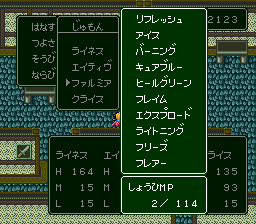
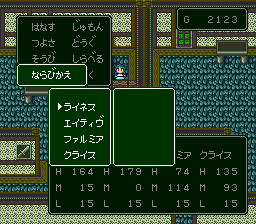
Order#
Order ならび rearranges the party: pick the members one by one in their new order, and the last falls into place by itself. A keeps the new order, B cancels. The order matters in battle, where enemies strike the front of the line more often than the back (How battles work).
Saving#
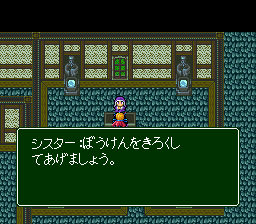
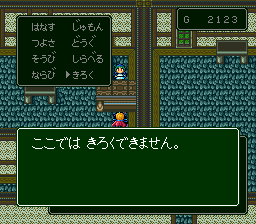
Record きろく saves the game. It works only on the field, and only on foot: on the ship, or anywhere inside a map, it answers きろくできません, you can't record here. Inside a map the only way to save is a save point that the maker placed as an event: FATE's are the sisters of its churches, among others.
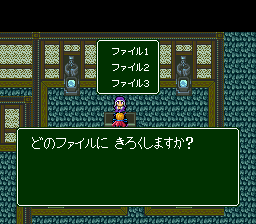
Either way the game offers File 1–3 ファイル1–3, with no preview of what is in each and no question before writing over one: pick a file and it is saved, ファイルNに きろくしました. B cancels. The three files are the same three play saves the title's Continue lists.
A save keeps the party and its order, gold, each hero's level, HP, MP, experience and ten items, the switches, where the party is and what it rides, the vehicles' places, and the places reached for teleport. Game over and resetting keep nothing: play since the last save is lost.
Towns, shops and inns#
Shops, inns and save points are events: a maker stands a person behind a counter and gives them the command. So their windows are the same in every game.
A shop おみせ sells up to four items. It opens straight on its menu, Buy かいにきた, Sell うりにきた and Leave やめる, with the gold beside it, and after each deal asks ほかに ごようは? ("anything else?").
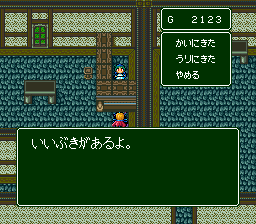
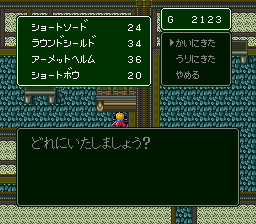
- Buying: pick the item, then who will carry it; the shop shows that hero's items. There is no comparison and no check that the hero can use it: a sword nobody can wield sells as readily as any other. A hero with ten items already is turned away. Each purchase is one item.
- Selling: pick the hero, then the item. The shop pays half the price, at least 1 gold. It politely refuses items marked × and items with a price of 0 (てばなさないほうが よろしいですよ: "better not part with that"). An equipped item can be sold, and comes off as it goes. Gold stops at 999,999.
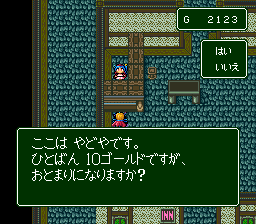
An inn やどや names its price for a night and asks whether you'll stay. Staying fades the music, plays the inn's tune , and restores every member's HP and MP. Poison and paralysis stay, and so would a fallen member, who gets full HP but remains fallen. With too little gold the innkeeper asks you to come back when you have it.
Poison and the swamp#
Poison takes HP at every step on the field, with a flash, but never takes HP below 1. It takes 2 HP a step, or 1 on a swamp, which looks like a slip in the program. Swamps take 1 HP a step from a member who isn't poisoned, also never below 1. There are no other damaging floors. In battle poison does nothing. An antidote, a cure spell or an event cures it; an inn doesn't.
The ship and the airship#
A game can have two vehicles, both on the field only: a ship and an airship. Whether a game has them, how each looks and where it waits at the start are the maker's choice (The database). Each vehicle stays where it was left.
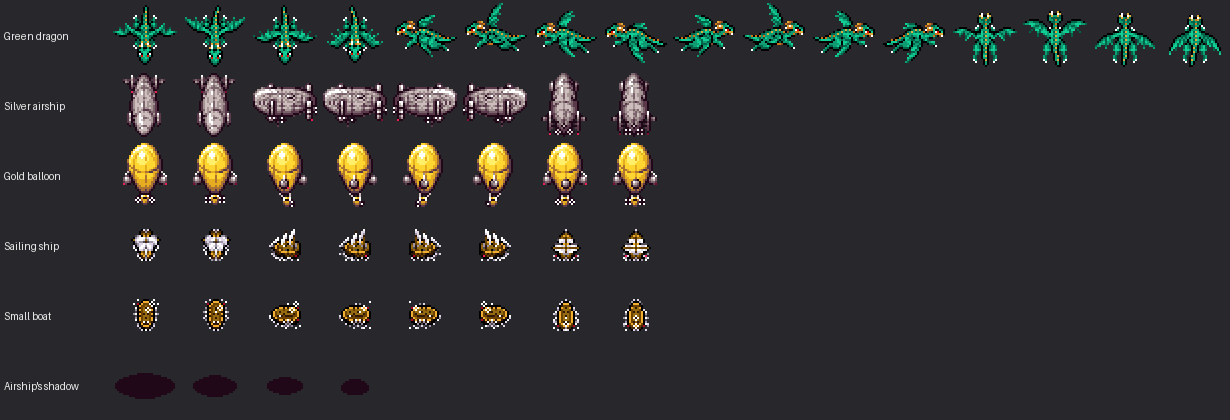
| Ship | Airship | |
|---|---|---|
| Looks like | A sailing ship or a small boat | A dragon, an airship or a balloon |
| Boarding | Walk into it | Step onto it |
| Goes over | The sea | Everything |
| Speed | 8 frames a cell, as on foot | 4 frames a cell, twice as fast |
| Battles | Yes, with the screen's sea enemies | None |
| Getting off | Steer onto a cell you can walk on | A: only over grass, desert or shore, and not where the party couldn't walk away |
| Command window | Yes, but no talking, searching or saving | No |
| Music | The ship's slot | The airship's slot as it takes off |
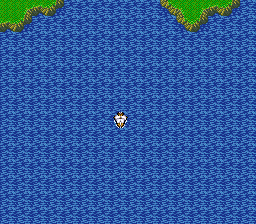
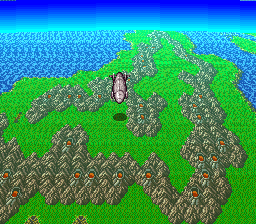
In the air the field tilts into perspective under a sky, with the airship's shadow below. Nothing attacks in the air. A lands, but not on forest, swamp or mountains, not on an event, and not on a cell the party couldn't walk off.
Battles#
Random battles happen on foot, in maps and on the field, and at sea. The enemies come from the set the maker painted for the screen the party is on (Maps and the field); a screen with none is safe. The chance rises with the steps since the last battle, the same everywhere: there is no rate to set.
| Steps since the last battle | Chance of a battle on this step |
|---|---|
| 1 | None |
| 2–7 | 1 in 256 |
| 8–12 | 2 in 256 (1 in 128) |
| 13–15 | 4 in 256 (1 in 64) |
| 16 and on | 1 in 8 |
So the first fifteen steps after a battle are nearly always free, and from the sixteenth a battle comes about one step in eight. Events can also start a battle, usually with a boss, and an event's battle can't be fled.
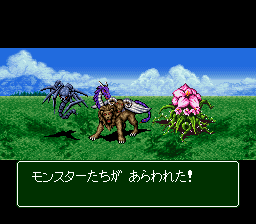
The battle is seen from the front: one to four enemies, never two of the same, over a background chosen by the map's kind (a castle hall, a cave, a town street) or by the ground underfoot on the field (grassland, desert, sea, forest, swamp, a rocky canyon). The party's names, HP and MP are in boxes across the top.
Commands#
Each round opens with a menu for the whole party:
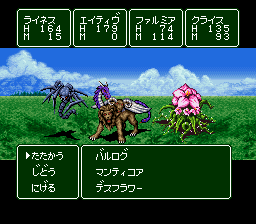 1234567
- 1 Party command たたかう じどう にげる chosen once a round, for the whole party
- 2 Fight たたかう each hero then picks Attack, Defend, Spells or Items
- 3 Auto じどう the heroes choose for themselves, this round only
- 4 Run にげる speed decides; a battle started by an event can't be fled
- 5 Enemies the group: one to four different enemies
- 6 Party each hero's HP and MP
- 7 Battlefield the enemies over a background chosen by the map's kind or the ground underfoot
| Command | Japanese | What it does |
|---|---|---|
| Fight | たたかう | Give each hero an order (below) |
| Auto | じどう | The heroes choose for themselves, this round only: a badly hurt hero is healed if someone can, otherwise they attack, with a spell or a weapon |
| Run | にげる | Try to run away. Speed decides the odds, rolled at the start of the round; an event's battle can't be fled |
| Attack | こうげき | Strike one enemy |
| Defend | ぼうぎょ | Halve the damage the hero takes from attacks this round |
| Spells | じゅもん | Cast a learned spell |
| Items | どうぐ | Use one of the hero's own items. Whatever is used is used up |
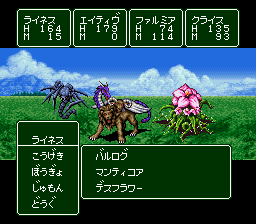
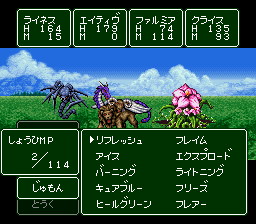
Then everyone acts, fastest first, ties going to the party. A few rules a player feels at once; the rest are in How battles work:
- Damage is attack − defence ÷ 2, with no random spread. An attack can do 0: a weak hero against a well-armoured enemy may never hurt it.
- A critical hit comes about one blow in sixteen .
- Enemies hit the front of the line more often: in a party of four, the leader takes six blows in sixteen and the last member two.
- Confusion makes a hero do nothing, rather than strike at random.
- Escape is decided by a roll at the start of each round. It always works if the party's slowest member is at least as fast as the fastest enemy, and becomes less likely the faster the enemies are.
- An item used in battle is always used up.
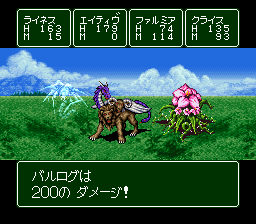
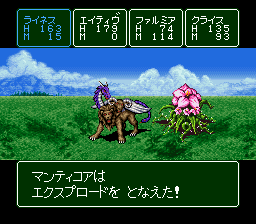
After a battle#
When the last enemy falls, the victory fanfare plays and the party wins the enemies' gold and experience: each hero gets the whole experience total, not a share. Then come the level-ups , one hero at a time: レベルが あがった!
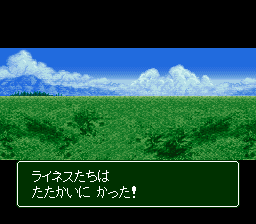
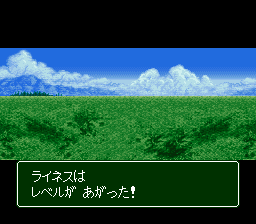
- A level adds the hero's growth to each of the five stats; attack, defence, maximum HP and MP follow from them, with the equipment on top. The experience needed climbs steeply to level 20 (42,149 in all), then by a flat 32,768 a level, to level 99. How battles work has the table.
- A fallen hero is back with 1 HP after the battle (by the code).
- There are no treasure chests after battles: an enemy gives gold and experience only.
- Levels change only in battle. An event can give experience, and the hero levels up only at the end of the next battle won.
Game over#
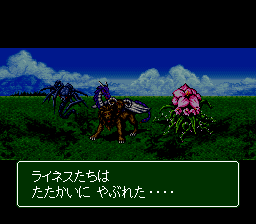
If the whole party falls, a short defeat tune plays and the screen says the party lost: 〈leader〉たちは たたかいに やぶれた・・・・. A button press returns to the title menu. Nothing is saved and nothing is kept: the game picks up again only from a play save.
The ending#
A game ends when an event gives the ending command. The screen fades, song 4 plays, and nine cards cross-fade over the nine battle backgrounds, each with two lines of the staff. Your game has one place in them: card 2, SCENARIO, shows your name from Title Settings. The rest are the program's own staff:
| Card | Lines |
|---|---|
| 1 | ORIGINAL N.YAMASHITA |
| 2 | SCENARIO, then your name from Title Settings |
| 3 | GRAPHIC T.MACHIDA / M.KON |
| 4 | PROGRAM T.SUZUKI |
| 5 | SOUND S.ISODA |
| 6 | SUBDIRECTOR D.TAKAMI |
| 7 | DIRECTOR Y.AOYAMA |
| 8 | SUPERVISOR T.YOSHINARI / K.FUCHIGAMI |
| 9 | PRODUCER A.KAWAMURA |
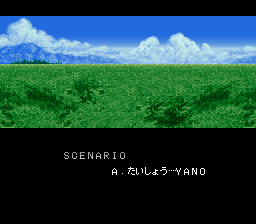
The roll takes about two minutes. There is no THE END: the program goes back to the opening demo. Nothing is saved, so a player who wants to keep a finished game should record before the last scene. A game that never reaches an ending command simply has no end.
Test play#
Edit → Test Play テストプレーのかいし plays your game as the cartridge holds it, so save every editor first (Getting started). New Game starts afresh with the title card; Continue picks a play save.
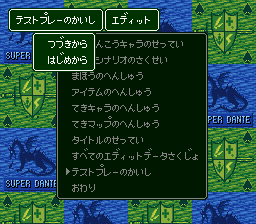
Test play has one tool: hold B while walking, on the field or in a map, and
- no battles start: the steps aren't even counted, and
- the party walks through walls, at the normal speed.
Let go and both stop. Nothing else changes: the same command window, no invincibility, no switch editor, no position readout. A game recorded in test play is tagged Test テスト, and continuing it, even from the Game menu, runs it as test play again.
To stop, hold L + R + START + SELECT: back to the title menu, in a test game or any other. Nothing is saved.
Fan-made reference material, one of the Eschaton Games Tsukuru guides. Not affiliated with the publishers of the titles it covers. Corrections and questions: contact@eschaton.games.