How battles work#
Super Dante's battles are simple and, once the dice are thrown, exact. Attacks always land, damage has no variance, spells do exactly their points, and the turn order has no luck in it. Chance enters in a few places only: critical hits, recovering from a status, an enemy's choice and its target, the half-miss method, the escape roll and the encounters themselves. This chapter gives every rule and formula, for a player who wants to know the odds and for a maker setting the numbers in the database. How a battle looks and is played from the pad is in Playing a game.
The rules were read from the game's code and then checked against the game itself: battles recorded in an emulator, 517 turns and 76 escape rolls, and again in a second emulator, 276 turns and 47 rolls, all replayed turn by turn through a model of these rules without one turn or roll coming out differently. Where a rule below is from the code alone, the text says so.
A round#
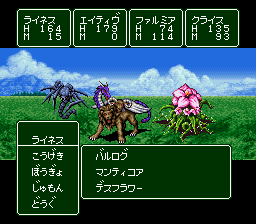
A battle is a series of rounds. In each, the party gives its commands, then everyone acts once, in order of speed:
The commands are those of the battle menu (Playing a game): Fight たたかう, which asks each hero for Attack こうげき, Defend ぼうぎょ, Spells じゅもん or Items どうぐ; Auto じどう, which lets every hero choose for itself this round (Auto); and Run にげる (Escape). A hero's Items are its own ten: there is no shared bag.
"Out of the fight" means dead, fled, or (for an enemy) hidden. Each side keeps a count of its members still in the fight, and the battle ends when either count reaches nothing.
The turn order#
| Rule | What it means |
|---|---|
| Once a round | The order is fixed after the commands, before anyone acts. A speed up or down changes the next round's order, not this one's |
| Speed, highest first | A hero's speed is its agility (with any ups and downs); an enemy's is its agility |
| No randomness | The same speeds always give the same order |
| Ties: heroes first | A hero and an enemy at the same speed: the hero acts first |
| Then the lower place | Two heroes at the same speed act in party order; two enemies, in the group's order |
So FATE's ライネス at level 2 (speed 6) always acts before a slime (agility 1), and a hero who casts an agility up on himself overtakes a faster enemy only from the next round.
Status first#
Before anyone acts, the game looks at its status, and the first of these that applies decides the turn:
| Check, in this order | A hero | An enemy |
|---|---|---|
| Out of the fight (dead, fled, hidden) | No turn | Dead: no turn, unless it has Revive: then it comes back, every turn, no roll. Hidden: 1 in 4 it reappears, else no turn. Fled: gone |
| Confused | 1 in 4 it recovers; otherwise it does nothing | The same |
| Paralysed | 1 in 8 it recovers; otherwise no turn | 1 in 4 it recovers; otherwise no turn |
| Asleep | 1 in 4 it wakes; otherwise no turn | The same |
| Knocked out | 1 in 4 it comes round; otherwise no turn | The same |
| None of these | Its command, or Auto's choice | One of its options, at random |
Recovering uses up the turn. A dead enemy with the Revive method comes back on each of its turns, at full HP and MP, with no roll and its statuses gone: the only way to beat it is to leave it the last enemy standing, so that the battle ends before its turn comes round.
Damage#
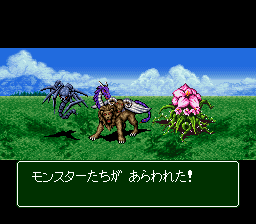
| Action | Damage | Notes |
|---|---|---|
| Attack | attack − defence ÷ 2 | ÷ rounds down. Below 0 becomes 1; exactly 0 stays 0 (below). No hit roll, no variance |
| Critical hit | attack − defence ÷ 4, at least 1 | 1 in 16 for everyone; 1 in 4 for an enemy with Critical up. かいしんのいちげき! |
| On a defending target | Halved, and 0 becomes 1 | Attacks and charges, the critical too. Spells are not halved |
| Half miss (enemy method 15) | None, 1 time in 2 | Rolled after the damage, on every attack, the critical too. Spells never miss |
| Charge (enemy) | attack − defence ÷ 2, at least 1; halved by a defender | Then the charger takes the target's attack − its own defence ÷ 2, at least 1, unless the target died or has a status other than poison |
| Self-destruct (enemy) | None | The enemy simply dies. No one is hurt and it gives no rewards |
| Steal MP (enemy) | A quarter of the target's MP, at least 1 | Only if the target has MP. The thief gains nothing |
| Damage spell | Its points, exactly | No defence, no variance. × 2 for an enemy with Double magic, at most 9,999. Only on a target it works on |
There is no hit roll and no variance. An attack does the same damage every time unless it is a critical. A blow landing sounds like this, from either side: When the damage reaches the target's HP, it falls: HP 0, MP 0, dead, and (for an enemy) its experience and gold go to the battle's totals.
Defence counts half. Against attack − defence ÷ 2, an enemy with defence 40 takes 20 off every blow, and a hero needs an attack above half an enemy's defence to do it any real harm. A critical hit counts only a quarter of the defence.
Defend ぼうぎょ halves the attacks and charges that land on the defender in that round, criticals too. It does nothing against spells.
Worked example: ライネス at level 2 has attack 22 and defence 28, and FATE's slime has attack 11, defence 14 and 16 HP. His blow does 22 − 7 = 15, so two kill it; a critical (22 − 14 ÷ 4 = 19) kills it at once. Its blow does 11 − 14 = less than 0, so 1. Armed with a short sword (power 8), he does 30 − 7 = 23 and kills it with every blow.
Charge is an enemy's heavy blow with a risk: after it lands, the target hits back with its own attack − the charger's defence ÷ 2, at least 1, which can kill the charger. A target that is asleep, paralysed, confused or knocked out doesn't hit back. A charger killed this way still gives its experience and gold.
Retargeting. An attack, charge, MP theft or one-target spell whose target is already out of the fight passes to the next member of that side, round to the first. So an attack is never wasted on the dead.
Magic#
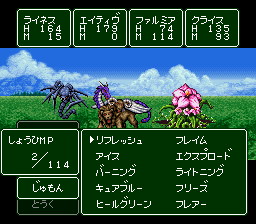
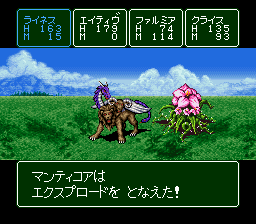
A hero casts a spell it knows. If it hasn't the MP, the turn is lost ("not enough MP"). The MP is paid before the spell does anything, so a spell that doesn't work on its target, or teleport, which does nothing in battle, still costs its MP. An enemy's MP is never checked: enemies have none. A sealed caster, hero or enemy, loses the turn; a sealed hero can still use a magic item.
Every spell is exact: its points are the amount, with no defence, no variance and no miss (Magic has the 32 slots). Heals stop at the maximum, ups at 9,999, downs at 1. A damage spell kills when its points are at least the target's HP. An enemy with Double magic casts at double points, at most 9,999: heals and ups too.
Resistance is all or nothing, and it applies to every target, of a one-target spell or an all-target one: a spell not ticked in an enemy's magic that works on it does nothing to that enemy. A hero is always affected.
An enemy casting makes its own sound ; a spell's animation is the one its graphic chooses, and graphic 0 shows none. The healing, teleport, revive, cure and boosting slots (0–7, 14–16) never show one.
Items#
| Kind | In battle |
|---|---|
| HP restore, MP restore | HP or MP + the power, up to the maximum, on the hero chosen. If that hero is down, it is wasted: it doesn't pass to another |
| Antidote | Ends poison (which does nothing in battle anyway) |
| Paralysis cure | Ends paralysis |
| Magic item | Casts its spell, with no MP and even when sealed. A teleport item does nothing and is kept |
| Anything else | Nothing happens, and the item is kept |
An item used is always used up: the first one of its kind in the hero's list goes and the rest move up. There is no break chance. Kinds that do nothing in battle are kept (The 14 kinds).
Status effects#
| Status | Caused by | In battle | Ended by |
|---|---|---|---|
| Poison どく | Spell 8; an event | Nothing at all: it hurts only on the field (1 HP a step, 2 off swamp ground, never below 1) | Spell 7, an antidote; a paralyse spell replaces it |
| Paralysed マヒ | Spell 9; an event | No turn: a hero recovers 1 in 8 a turn, an enemy 1 in 4. On the field it can't use items or cast | Spell 7, a paralysis cure; a poison spell replaces it |
| Sealed | Spell 10 | Can't cast: the turn is lost. Magic items still work | — |
| Confused | Spell 11 | Does nothing; recovers 1 in 4 a turn | — |
| Asleep | Spell 12 | No turn; wakes 1 in 4 a turn | — |
| Knocked out きぜつ | Spell 13 | No turn; comes round 1 in 4 a turn | Spell 6, revive |
| Hidden | An enemy's own choice | Out of the fight; back 1 in 4 a turn | — |
| Dead | HP 0 | Out of the fight. Nothing brings a hero back in battle | The battle's end: the hero is back with 1 HP |
The spells that confuse, put to sleep and knock out replace each other and paralysis: putting a paralysed enemy to sleep ends its paralysis. Poison and paralysis replace each other too.
How enemies choose#
On its turn an enemy that can act picks one option, every option at equal odds: each of the battle methods 0–7 it has (Battle methods) and each spell it casts counts as one. So an enemy with Attack, Defend and two spells attacks a quarter of the time and casts half of it. An enemy with nothing at all does nothing.
Then it picks the target by what it chose:
| Option | Its target | With Protect itself (11) | With Attack itself (12) | With Attack its side (13) |
|---|---|---|---|---|
| Attack, Charge, Steal MP | A random hero | — | Itself (attack only) | A random ally (attack only) |
| Heal one, revive, cure (spells 0–2, 6, 7) | A random ally, alive | Itself | — | — |
| Heal all (3, 4) | Its own side | — | — | — |
| Ups (14–16) | A random ally, alive | Itself | — | A random hero |
| Statuses, downs, damage one (8–13, 17–22, 26–28) | A random hero | — | Itself | A random ally, alive |
| Damage all (23–25, 29–31) | The party | — | Its own side | Its own side |
| Teleport (5) | Nothing happens | — | — | — |
A random hero is not an even draw. The game rolls a number from 0 to 15 and looks it up in a table by the party's size, so the front of the party is hit far more often. These are the chances in sixteenths:
| Party of | Hero 1 | Hero 2 | Hero 3 | Hero 4 |
|---|---|---|---|---|
| 1 | 16 | — | — | — |
| 2 | 11 | 5 | — | — |
| 3 | 7 | 5 | 4 | — |
| 4 | 6 | 4 | 4 | 2 |
The fallen are not skipped: a blow drawn for a dead hero passes to the next one (Retargeting), so with the first hero down, the second takes the first's share as well. A random ally, on the enemies' side, is an even draw among the living.
Attack twice (method 8) is a second whole turn, straight after the first: a new choice with its own roll, so an enemy may attack and then cast. It never takes a third. The recordings showed it after attacks, spells, charges and revivals, but not after defending or a turn lost to a status.
Hide, flee and self-destruct all take an enemy out of the fight. A hidden enemy comes back 1 in 4 a turn; a fled one is gone and gives nothing; a self-destructing one simply dies, with no blast and no rewards. Steal MP takes a quarter of a hero's MP and gives the thief nothing. A reviving enemy gives its experience and gold again each time it falls, since every kill counts.
Auto#
Auto じどう chooses for each hero in party order, just before the first turn of the round, by a fixed list. It uses no random numbers except to pick an enemy:
| Step | Auto does |
|---|---|
| A hero with any status but poison | Nothing |
| The first hero in party order who is alive, below a quarter of max HP and not already being healed this round gets help: the first heal spell (slots 0–4) in the deciding hero's list, if it has the MP; else its first HP restore, or magic item with a heal spell, from its own items. That hero is marked, so the next hero looks further down the party |
| If any of its damage spells (slots 20–31) has more points than its attack and is affordable, it casts the last damage spell in its list, at a random living enemy (the bug below) |
| It attacks a random living enemy |
Auto never uses an MP restore, an antidote or a cure, and never casts a status spell, an up or a down: those are the menu's to choose.
Escape#
Run にげる works if this round's roll says so. The roll is made at the start of every round, on the speeds of the members still in the fight, before anyone chooses:
| Test, in this order | Run works |
|---|---|
| The slowest hero is at least as fast as the fastest enemy | Always |
| The slowest enemy is at least as fast as the fastest hero | 1 in 16 |
| The heroes' average speed is at least the enemies' | 1 in 4 |
| Otherwise | 1 in 8 |
| Then, over whatever the roll said: | |
| A battle started by an event | Never |
| None of the counted heroes can act (out, knocked out, asleep, paralysed or confused) | Never |
| None of the counted enemies can act | Always |
So ライネス alone always escapes from a slime, as he is faster. Speed is the only stat that counts, and a battle started by an event can't be fled at all. Super Dante adds the last two rules to RT2's: a party none of whose members can act can't run, and a group none of whose members can act can't stop it.
After the battle#
Rewards#
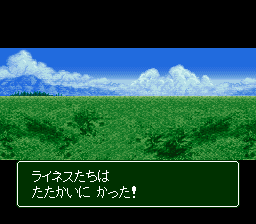
Each enemy killed adds its experience and gold to the battle's totals (at most 9,999,999 experience and 999,999 gold). An enemy that fled or blew itself up gives nothing. At the end the victory fanfare plays , and each hero in the party gets the whole experience total, not a share of it. There is no chest and no item drop: items come only from events and shops.
Experience and levels#
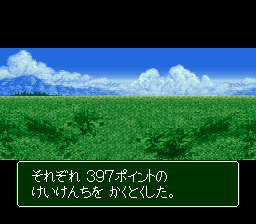
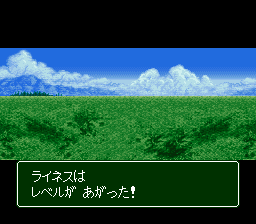
The experience a hero needs is a fixed total for each level, the same for every hero, and the same table as RT2's:
| Level | Total experience | Level | Total experience |
|---|---|---|---|
| 1 | 0 | 11 | 1,084 |
| 2 | 10 | 12 | 1,633 |
| 3 | 25 | 13 | 2,456 |
| 4 | 47 | 14 | 3,690 |
| 5 | 80 | 15 | 5,541 |
| 6 | 129 | 16 | 8,317 |
| 7 | 202 | 17 | 12,481 |
| 8 | 311 | 18 | 18,727 |
| 9 | 474 | 19 | 28,096 |
| 10 | 718 | 20 | 42,149 |
From level 21 on, every level costs exactly 32,768 more: level L takes (L − 20) × 32,768 + 42,149. The highest level is 99, and a hero's experience stops at 9,999,999.
| Level | Total experience |
|---|---|
| 21 | 74,917 |
| 25 | 205,989 |
| 30 | 369,829 |
| 40 | 697,509 |
| 50 | 1,025,189 |
| 60 | 1,352,869 |
| 70 | 1,680,549 |
| 80 | 2,008,229 |
| 90 | 2,335,909 |
| 99 | 2,630,821 |
A level-up adds the hero's five gains to its stats and works out attack, defence, speed, max HP and max MP again, equipment included (How stats grow). Several levels at once each add their gains. Spells come with the levels set in the hero's Magic Level (Magic Level).
Back to the field#
A hero who died comes back with 1 HP once the battle is over (from the code), so play never leaves a dead hero on the field. If the whole party falls, the defeat sound plays , the game says that the leader's party lost the fight, and it goes back to the title menu. Nothing is saved, and play since the last save is lost (Playing a game).
Encounters#
A random battle can start after each step, on foot or aboard the ship; never in the air. The chance depends only on the steps since the last battle, counted afresh after each battle, each change of map, each warp and the start of play:
| Steps since the last battle | Chance a step | Battles started by then |
|---|---|---|
| 1 | None | 0 % |
| 2–7 | 1 in 256 | 2 % |
| 8–12 | 2 in 256 | 6 % |
| 13–15 | 4 in 256 | 10 % |
| 16 and on | 1 in 8 | 54 % by the 20th, 76 % by the 25th, 88 % by the 30th |
There is no rate to set: every screen with enemies uses this one curve. The first step is always safe, the next fourteen almost safe (one battle in ten comes that early), and from the 16th step a battle comes one step in eight. Half of all battles have come by the 20th step; on average one comes every 22 steps. A screen with no enemies ticked in Enemy Maps has none at all. In test play, holding B stops encounters (Playing a game).
The group. The game takes the enemies the screen allows (on the field only the land ones on foot, the sea ones aboard the ship), shuffles them, and draws a size of 1, 2, 3 or 4, each as likely, capped at the number allowed. It takes that many from the shuffled list, never the same enemy twice, and stops early if the next enemy's picture would not fit across the screen. So a screen with one enemy ticked always gives fights against that one alone.
An event's battle names up to four enemies, all from one set (Events). They come out in number order and each once: an event that names enemies 3, 3 and 1 fights 1 and 3. There is no shuffle and no size roll, but the width still limits them.
The background comes from where the battle is: on a map, from its kind (a castle hall, a cave, a town street); on the field, from the ground under the party (Battle backgrounds). Every battle plays the start's battle song (The start).
The random numbers#
Every roll above comes from one generator, RT2's: s = s × 5 + 14,097, kept to 16 bits, with each step's top byte as the number (0–255). Rolls such as "1 in 4" and "1 in 16" test bits of that byte and are exact. "One of n" (an enemy's option, a random ally) takes the byte's remainder by n, so for n that doesn't divide 256 the first options come up very slightly more often.
Unlike RT2, Super Dante doesn't seem to draw numbers while it waits for each frame: in two emulators, the same presses from switching on gave the same numbers at the same places and the same battles. The generator and its place in the program are in How it works.
Fan-made reference material, one of the Eschaton Games Tsukuru guides. Not affiliated with the publishers of the titles it covers. Corrections and questions: contact@eschaton.games.