The database#
The database is what a game knows before its story starts: the heroes and how they grow, the items, the spells, the enemies, and how a new game begins. Four entries of the Edit menu エディット hold it (Getting started):
| Entry | Japanese | What it holds | How many |
|---|---|---|---|
| Heroes | しゅじんこうキャラのせってい | Name, graphic, the level each spell is learned at, starting level, the five gains a level | 8 heroes |
| Magic | まほうのへんしゅう | Name, MP cost, points and animation; the effect is fixed by the slot | 32 spells |
| Items | アイテムのへんしゅう | Name, price, kind, who can equip it, power | 128 places (127 to use) |
| Enemies | てきキャラのへんしゅう | Name, picture, where it appears, six numbers, battle methods, the spells it casts and the spells that work on it | 80: 32 field, 32 dungeon, 16 event |
Each editor works on its own copy and writes it to the cartridge only when you choose Save セーブ from its R menu. Its Sample Load サンプルロード replaces that one editor's data with the sample game's, which is a quick way to see a working example and a good start for your own (The R menu). The title and your name are in Title Settings (Getting started); where enemies appear is set in Enemy Maps (Maps and the field); what the numbers do in a fight is How battles work.
The examples on this page are the sample game, FATE, as the cartridge ships it. Its database is a good one to read: a Norse story with eight heroes, sixty-odd items, all 32 spells named and used, and 74 of the 80 enemies filled in (The sample game).
Heroes#
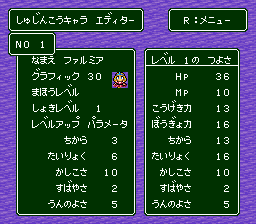 12345678910111213141516
- 1 Heroes しゅじんこうキャラ エディター the editor's name
- 2 R menu R:メニュー Type, Save, Sample Load, Undo, End
- 3 Hero number NO 1 heroes 0–7
- 4 Name なまえ up to 5 characters
- 5 Graphic グラフィック one of the 54 characters; 0 for none
- 6 The graphic the chosen character, as it walks
- 7 Magic Level まほうレベル the level at which this hero learns each of the 32 spells; 99 never
- 8 Starting Level しょきレベル the hero's level at a new game
- 9 Level-up gains レベルアップ パラメータ what each level adds to the five stats below
- 10 Strength gain ちから attack
- 11 Vitality gain たいりょく defence and max HP
- 12 Intelligence gain かしこさ max MP
- 13 Agility gain すばやさ speed: turn order and escape
- 14 Luck gain うんのよさ no battle rule reads it
- 15 Strength at a level レベル n の つよさ the right column is worked out for this level
- 16 The stats HP … うんのよさ HP, MP, attack, defence and the five stats at that level, without equipment
Heroes しゅじんこうキャラのせってい holds 8 heroes, of whom up to four travel in the party at once. Events bring them in and take them out (Events). Each has:
- a name なまえ of up to 5 characters;
- a graphic グラフィック: one of the 54 characters of the catalogue, or 0 for none, which the game draws as nothing at all;
- a Magic Level まほうレベル: for each of the 32 spells, the level at which this hero knows it (below);
- a Starting Level しょきレベル: the hero's level at a new game;
- five gains a level レベルアップ パラメータ: what each level adds to Strength ちから, Vitality たいりょく, Intelligence かしこさ, Agility すばやさ and Luck うんのよさ.
Beside them, レベル n の つよさ ("strength at level n") works out what those gains come to: HP, MP, Attack こうげき力, Defence ぼうぎょ力 and the five stats.
The R menu adds Type タイプ, which fills in the five gains from a preset: hero えいゆう, warrior せんし, mage まほうつかい, priest そうりょ, sage けんじゃ or thief とうぞく. The type itself isn't kept: it is a quick way to start, and the gains can be changed after.
There is no starting equipment: every hero starts a new game with nothing carried and nothing worn, and gets items from events and shops.
How stats grow#
The five numbers are gains, not stats. A hero at level L has:
| Stat | At level L | What it gives |
|---|---|---|
| Strength ちから | 10 + L × gain | Attack = strength + the weapon's power |
| Vitality たいりょく | 10 + L × gain | Defence = vitality + the armour's (below); max HP = vitality + 20 |
| Intelligence かしこさ | L × gain | Max MP = intelligence |
| Agility すばやさ | L × gain | Speed: the turn order and the escape roll |
| Luck うんのよさ | L × gain | Nothing: no battle rule reads it |
So max HP is 30 + level × the vitality gain, and max MP is level × the intelligence gain. The editor's right column shows it: ファルミア's vitality gain of 6 at level 1 gives vitality 16, defence 16 and 36 HP, and a hero with every gain at 0 shows the bases alone, 10 strength, 10 vitality, 30 HP and nothing else. A level-up adds each gain once and works the rest out again, the equipment included (Experience and levels). The stats depend only on the level, not on how the hero got there, so a hero who first joins at level 10 is exactly as strong as one who walked there.
The worn equipment is added on top: the weapon's power to attack, the armour's, shield's and helmet's to defence. FATE has no rings, and what a ring's power adds has not been checked.
Worked example: FATE's hero, ライネス, has the gains 6, 9, 1, 3, 4 and starting level 2:
| Gain | Level 2 (his start) | Level 19 | |
|---|---|---|---|
| Strength → attack | 6 | 22 | 124 |
| Vitality → defence | 9 | 28 | 181 |
| Max HP | (vitality + 20) | 48 | 201 |
| Intelligence → max MP | 1 | 2 | 19 |
| Agility → speed | 3 | 6 | 57 |
| Luck | 4 | 8 | 76 |
The level 19 column is not just arithmetic: the sample's own first play save has him at level 19 with 201 HP and 19 MP, exactly what the gains give. A gain can be large: a hero with 99 in each reaches 10 + 99 × 99 = 9,811 at level 99.
What the stats do#
- Attack and defence: an attack does the attacker's attack − the target's defence ÷ 2. Defence counts half (Damage).
- Agility is the speed of the turn order and of the escape roll (The turn order, Escape).
- Intelligence gives MP and nothing else: a spell does its points whoever casts it.
- Luck does nothing in a fight. None of the battle's rules reads it, and there are no chests after a battle for it to help with.
Magic Level#
Magic Level opens a list of the 32 spells with a level for each: the level from which this hero knows that spell. 99 means never. The spells are shared: there is one list of 32 (Magic), and each hero learns from it at its own levels. A spell that no hero learns is one only enemies cast.
A hero knows the spells whose level it has reached, so a level at or below the starting level gives a spell from the first step. The field's spell list and the battle's show them in the order they were learned.
FATE's heroes#
| Hero | Name | Graphic | Starting Level | Gains (Str, Vit, Int, Agi, Luck) | Spells |
|---|---|---|---|---|---|
| 0 | ふね (ship) | 52 | 1 | 0, 0, 0, 0, 0 | None |
| 1 | ファルミア | 30 | 1 | 3, 6, 10, 2, 5 | None |
| 2 | ライネス, the hero | 1 | 2 | 6, 9, 1, 3, 4 | Teleport at level 3 |
| 3 | ファルミア | 3 | 2 | 3, 6, 10, 2, 5 | Eighteen: heals from level 2, fire from 2, ice from 5, lightning from 12, ライトセイバー at 20 |
| 4 | エイティヴ | 4 | 7 | 8, 10, 0, 1, 3 | None |
| 5 | クライス | 20 | 10 | 4, 7, 7, 4, 5 | Seventeen: heals, revive, cure, every status spell, the ups and the downs, from level 10 to 20 |
| 6 | うあんねす | 8 | 1 | 0, 0, 0, 0, 0 | None |
| 7 | とーめい (invisible) | 0 | 1 | 0, 0, 0, 0, 0 | None |
FATE plays with heroes 2–5 as its party of four: ライネス the swordsman, ファルミア the magic user, エイティヴ and クライス, who join already at levels 7 and 10. Three of the others are tools, as in RPG Tsukuru 2's sample: a ship hero, an invisible one with graphic 0, and hero 6, whom the game starts with alone in its opening scene (The start). Hero 1 is a second ファルミア with another graphic and no spells.
Items#
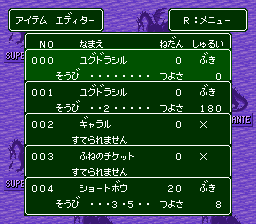 123456789
- 1 Items アイテム エディター 128 items, five to a page
- 2 R menu R:メニュー Copy, Delete, Save, Sample Load, Undo, End
- 3 Item number 000 000–127
- 4 Name なまえ up to 8 characters
- 5 Price ねだん 0–9,999; shops buy back at half
- 6 Kind しゅるい one of 14: weapon, armour, HP restore …
- 7 Who can equip そうび a mark for each of the 8 heroes: the hero's number where it can wear it
- 8 Power つよさ attack, defence, the amount restored, or a spell's number
- 9 Can't be thrown away すてられません shown for the kind ×: no discarding, no selling
Items アイテムのへんしゅう holds 128 items. The last place is empty in every save seen, so plan on 127. Items have no pictures. Each has:
- a name なまえ of up to 8 characters;
- a price ねだん, 0–9,999;
- a kind しゅるい, one of 14 (below);
- who can equip そうび it: a mark for each of the 8 heroes, shown as the hero's number where that hero may wear it and a dot where not (FATE's short bow reads ・・・3・5・・);
- a power つよさ, 0–9,999, whose meaning depends on the kind.
The R menu adds Copy コピー and Delete さくじょ for whole items.
The 14 kinds#
| Kind | On screen | What it is | Its power | Used up? |
|---|---|---|---|---|
| 0 | × | A plain item that can't be thrown away or sold (the editor adds すてられません) | Unused | No: using it does nothing |
| 1 | ○ | A plain item that can be (すてられます) | Unused | No: using it does nothing |
| 2 | ぶき | Weapon | Added to attack | Worn, not used |
| 3 | よろい | Armour | Added to defence | Worn, not used |
| 4 | たて | Shield | Added to defence | Worn, not used |
| 5 | かぶと | Helmet | Added to defence | Worn, not used |
| 6 | ゆびわ | Ring | Not checked (FATE has no rings) | Worn, not used |
| 7 | かぎ | Key: used facing an event that starts "when a key is used", it sets that event off | Keep it at 0 (below) | No |
| 8 | MPかいふく | MP restore | MP restored (MPが かいふくする りょう) | Yes |
| 9 | HPかいふく | HP restore | HP restored (HPが かいふくする りょう) | Yes |
| 10 | どくけし | Antidote: cures poison | Unused | Yes |
| 11 | マヒやく | Paralysis cure | Unused | Yes |
| 12 | まほう | Magic item: casts a spell, with no MP | The spell's number, 0–31 | Yes (a teleport item is kept in battle) |
| 13 | イベント | Event item: does nothing when used; events check whether the party has it | Unused | No |
Equipment (weapon to ring) is worn, not used: through the field's Equip command, by a hero ticked under who can equip it. A shop sells it to anyone, though, with no check and no comparison, so a hero can carry what it can't wear (Playing a game). Taking an item off keeps it.
Each hero carries ten items, with no shared bag and no counts: five potions take five places. Worn items count among the ten.
What "used up" means: an HP or MP restore, an antidote, a paralysis cure or a magic item goes when it is used, in the field and in battle alike. There is no break chance: one use, one item. The other kinds are never used up.
A magic item casts the spell whose number is its power: FATE's ヴェルントのはね has power 5 and teleports, そせいのは 6 and revives. In battle it casts that spell with no MP, even for a sealed hero. In the field only the heals, teleport and the cure work, and a magic item whose spell is for battle only does nothing and is kept.
A key is used from the field's item list, facing an event whose start condition is when a key is used かぎを つかったとき, and that event runs; the key is kept (Events). Leave a key's power at 0: as the game's code compares it, no other value can match an event.
An event item does nothing when used (and leaves its window open), but an event page can ask whether any member of the party carries it, worn or not. FATE's horn ギャラル and ship ticket are of kind ×, which does the same for events and also can't be thrown away.
Prices, selling and throwing away#
A shop sells an item at its price and buys it back for half, rounded down, at least 1 G. An item of kind × or with price 0 can't be sold or thrown away (これは すてられません。): that is the way to make a quest item stay. Worn items can be sold; they come off as they go.
FATE's consumables show how its prices and powers run:
| Item | Kind | Power | Price |
|---|---|---|---|
| やくそう | HP restore | 30 | 3 |
| ポーション | HP restore | 80 | 8 |
| キュアツール | HP restore | 160 | 22 |
| フレイヤのなみだ | HP restore | 9,999 | 50 |
| せかいじゅのたね | MP restore | 30 | 5 |
| せかいじゅのは | MP restore | 80 | 10 |
| せかいじゅのみ | MP restore | 160 | 25 |
| クヴァシルのさけ | MP restore | 9,999 | 60 |
| ヴェルントのはね | Magic | 5: teleport | 8 |
| そせいのは | Magic | 6: revive | 20 |
| イズンのリンゴ | Magic | 7: cure | 10 |
| どくけしそう | Antidote | — | 4 |
| まひかいふくやく | Paralysis cure | — | 7 |
Magic#
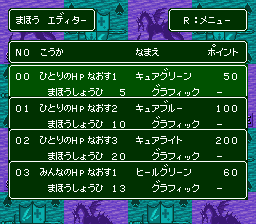 12345678
- 1 Magic まほう エディター the 32 spells, four to a page
- 2 R menu R:メニュー Save, Sample Load, Undo, End
- 3 Slot 00 00–31: the slot fixes what the spell does
- 4 Effect こうか the slot's effect, shown, not chosen
- 5 Name なまえ up to 8 characters
- 6 Points ポイント how much it heals, harms or raises, 0–9,999
- 7 MP cost まほうしょうひ what a hero pays to cast it; enemies pay nothing
- 8 Graphic グラフィック the battle animation, one of 13, or none
Magic まほうのへんしゅう holds 32 spells, shared by the heroes (each learns them at its Magic Level) and the enemies (each has a list of the ones it casts). A spell has:
- a name なまえ of up to 8 characters;
- its effect こうか, which you can't choose: the spell's slot is its effect. Slot 0 always heals one, slot 13 always knocks out, slot 31 always damages all;
- an MP cost まほうしょうひ, what a hero pays to cast it;
- points ポイント, 0–9,999: the amount it heals, harms, raises or lowers;
- a graphic グラフィック, the battle animation: one of the 13 of the catalogue, or none. The slots that heal, teleport, revive, cure or raise a stat (0–7 and 14–16) never animate, and show – here; on the others graphic 0 plays none.
So the design work is in the names and the numbers. These are the 32, with what FATE made of each:
| Slot | Effect | On screen | What it does | FATE's spell | MP | Points |
|---|---|---|---|---|---|---|
| 0 | Heal one 1 | ひとりのHPなおす1 | HP + points, up to the maximum | キュアグリーン | 5 | 50 |
| 1 | Heal one 2 | ひとりのHPなおす2 | The same | キュアブルー | 10 | 100 |
| 2 | Heal one 3 | ひとりのHPなおす3 | The same | キュアライト | 20 | 200 |
| 3 | Heal all 1 | みんなのHPなおす1 | The same, on each member of a side | ヒールグリーン | 13 | 60 |
| 4 | Heal all 2 | みんなのHPなおす2 | The same | ヒールブルー | 25 | 120 |
| 5 | Teleport | テレポート | Field only: back to a place already visited. In battle nothing, and the MP is spent | フリーゲート | 2 | 0 |
| 6 | Revive | きぜつを なおす | Ends knocked out (not death) | リカバー | 6 | 0 |
| 7 | Cure | どく、マヒを なおす | Ends poison and paralysis | リフレッシュ | 2 | 0 |
| 8 | Poison | どくを かける | Poisons (and ends paralysis) | ブラッドボイル | 5 | 0 |
| 9 | Paralyse | マヒさせる | Paralyses (and ends poison) | レッドアウト | 10 | 0 |
| 10 | Seal | まほうを ふうじる | The target can't cast | スペルバースト | 12 | 0 |
| 11 | Confuse | こんらん させる | Confuses | イリュージュン | 10 | 0 |
| 12 | Sleep | ねむらせる | Puts to sleep | トゥインクル | 10 | 0 |
| 13 | Knock out | きぜつ させる | Knocks out | デストロイ | 30 | 0 |
| 14 | Attack up | こうげき力を あげる | Attack + points, at most 9,999 | パワーアップ | 5 | 10 |
| 15 | Defence up | ぼうぎょ力を あげる | Defence + points | ガード | 5 | 10 |
| 16 | Agility up | すばやさを あげる | Speed + points | ダッシュ | 5 | 10 |
| 17 | Attack down | こうげき力を さげる | Attack − points, at least 1 | パワーダウン | 7 | 10 |
| 18 | Defence down | ぼうぎょ力を さげる | Defence − points | ソフト | 7 | 10 |
| 19 | Agility down | すばやさを さげる | Speed − points | ヘビー | 7 | 10 |
| 20 | Damage one A1 | ひとりにダメージA1 | HP − points, exactly | ファイアー | 3 | 20 |
| 21 | Damage one A2 | ひとりにダメージA2 | The same | フレイム | 13 | 60 |
| 22 | Damage one A3 | ひとりにダメージA3 | The same | スパーク | 28 | 100 |
| 23 | Damage all A1 | みんなにダメージA1 | The same on each member of a side | バーニング | 8 | 18 |
| 24 | Damage all A2 | みんなにダメージA2 | The same | エクスプロード | 14 | 35 |
| 25 | Damage all A3 | みんなにダメージA3 | The same | フレアー | 26 | 70 |
| 26 | Damage one B1 | ひとりにダメージB1 | HP − points, exactly | アイス | 7 | 40 |
| 27 | Damage one B2 | ひとりにダメージB2 | The same | フリーズ | 20 | 80 |
| 28 | Damage one B3 | ひとりにダメージB3 | The same | ライトセイバー | 38 | 200 |
| 29 | Damage all B1 | みんなにダメージB1 | The same on each member of a side | ライトニング | 20 | 52 |
| 30 | Damage all B2 | みんなにダメージB2 | The same | サンダーボルト | 31 | 85 |
| 31 | Damage all B3 | みんなにダメージB3 | The same | ダークセイバー | 0 | 100 |
The points are exact. A spell has no variance and ignores defence: FATE's スパーク takes 100 HP from anything it works on. A damage spell kills when its points reach the target's HP. Heals stop at the maximum, ups at 9,999, downs at 1. Status spells (6–13) use no points.
Damage A and damage B are the same effect. The two sets of six do the same thing; what tells them apart is each enemy's list of the spells that work on it (Enemies). FATE uses A for fire and B for ice, light and lightning, so a fire spirit can shrug off its fire.
Field or battle. Spells 0–7 can be cast from the field's Spells command; 8–31 are for battle only. Teleport (5) does nothing in a battle but still costs its MP. Revive (6) cast in the field only says that the hero has woken: a hero who fell in battle is back with 1 HP once the battle ends anyway (How battles work).
Teleport takes the party back to a place it has been. Its list is built from the field's first 32 events: each that has taken the party into a map adds that map, shown by its name. That is read from the game's code; the study didn't cast it (Playing a game).
Enemies#
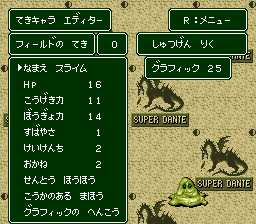 1234567891011121314151617
- 1 Enemies てきキャラ エディター the editor's name
- 2 R menu R:メニュー Save, Sample Load, Undo, End
- 3 Set フィールドの てき field, dungeon or event enemies
- 4 Number 0 the enemy in its set
- 5 Appears しゅつげん りく land and sea, land, or sea: field enemies only
- 6 Graphic グラフィック 25 one of the 54 enemy pictures
- 7 Name なまえ up to 8 characters
- 8 HP HP up to 9,999
- 9 Attack こうげき力 damage = attack − defence ÷ 2
- 10 Defence ぼうぎょ力 counts half against attacks; nothing against spells
- 11 Agility すばやさ its speed: turn order and the escape roll
- 12 Experience けいけんち given to the heroes when it is killed
- 13 Gold おかね given when it is killed
- 14 Battle Method せんとう ほうほう what it does: 16 methods
- 15 Magic that works on it こうかのある まほう each of the 32 spells, ○ or ×
- 16 Change graphic グラフィックの へんこう picks the picture
- 17 The picture the enemy as it looks in battle
Enemies てきキャラのへんしゅう holds 80 enemies in three sets:
| Set | On screen | How many | Where they fight |
|---|---|---|---|
| Field enemies | フィールドの てき | 32 | On the field, by the field's enemy map; each set to appear on land, at sea or both |
| Dungeon enemies | ダンジョンの てき | 32 | On every map, castles and towns too, by the map screen's enemy setting |
| Event enemies | イベントの てき | 16 | Only in an event's battle: the bosses |
Which enemies a screen can throw at the party is set in Enemy Maps (Maps and the field). A random battle draws 1–4 different enemies from those (Encounters); an event's battle names up to four, all from one set (Events). Each enemy has:
- a name of up to 8 characters and a picture, one of the 54 enemy graphics (the catalogue), each with its own colours; there is no colour choice;
- for field enemies, where it appears しゅつげん: land and sea りく、うみ, land りく or sea うみ. On foot only land enemies are drawn, aboard the ship only sea enemies;
- HP, Attack こうげき力, Defence ぼうぎょ力, Agility すばやさ, Experience けいけんち and Gold おかね, each up to 9,999;
- its Battle Method せんとう ほうほう (below), and the spells it casts, any of the 32;
- the magic that works on it こうかのある まほう (below).
Enemies have no MP and no luck. They cast for nothing, as often as they pick a spell.
Battle methods#
There are 16 battle methods, ticked as many as you like. Methods 0–7 are choices: things the enemy can do on its turn. Methods 8–15 change how it does them.
| 0 | Attack | ふつうの こうげき | A choice: attack a hero |
|---|---|---|---|
| 1 | Defend | ぼうぎょ する | A choice: guard, halving attacks on it |
| 2 | Hide | かくれる | A choice: hide, out of the fight; it comes back at 1 in 4 a turn |
| 3 | Flee | にげる | A choice: leave the battle, with no rewards |
| 4 | Charge | とつげき する | A choice: a blow that the target may hit back |
| 5 | Self-destruct | じばく する | A choice: the enemy simply dies, hurting no one and giving nothing |
| 6 | Steal MP | MPを うばう | A choice: a hero loses a quarter of its MP |
| 7 | Do nothing | なにも しない | A choice: waste the turn |
| 8 | Attack twice | いちどに 2かい こうげき | After its turn, a second whole turn straight away |
| 9 | Revive | いきかえる | Dead, it comes back on every one of its turns, at full HP |
| 10 | Double magic | まほうこうか 2ばい | Its spells' points × 2, at most 9,999 |
| 11 | Protect itself | じぶんに ぼうぎょまほう | Its heals, revive, cure and ups go on itself, not an ally |
| 12 | Attack itself | じぶんを こうげき | Its attacks and hostile spells go on itself (or its own side) |
| 13 | Attack its side | みかたを こうげき | Its attacks and hostile spells go on its allies, its ups on a hero |
| 14 | Critical up | つうこんのいちげき アップ | Critical hits 1 in 4 instead of 1 in 16 |
| 15 | Half miss | こうげき2かいに1かいミス | Each attack misses at 1 in 2 (spells are unaffected) |
How an enemy chooses: on each turn it picks one option at equal odds from the methods 0–7 it has and the spells it casts. An enemy with Attack and three spells casts three turns in four; one with Attack alone always attacks; one with nothing ticked does nothing. Whom it aims at, and the exact rules for each method, are in How battles work.
Magic that works on it#
For each of the 32 spells, whether it affects this enemy. A spell not ticked does nothing to it at all, whatever it is: a fire spell, a sleep spell or a heal from its own side. Heroes have no such list; every spell works on them. A new project ticks every spell for every enemy.
FATE uses it with care. Its last bosses are spared most or all of the status spells 8–13, so 魔王デュー can't be poisoned, put to sleep or knocked out; the fire spirit ignores the fire spells and the water spirit the ice ones; and ヴァンネス, the man in black, can be hurt by one damage spell only, ライトセイバー, which ファルミア learns at level 20.
FATE's enemies#
| Enemy | Set | HP, attack, defence, agility | Exp., gold | Methods | Casts | Notes |
|---|---|---|---|---|---|---|
| スライム | Field | 16, 11, 14, 1 | 2, 2 | Attack | — | The first enemy |
| デス | Field | 50, 63, 76, 15 | 30, 32 | Attack, Revive | — | Comes back while its group fights on |
| ミミック | Field | 150, 78, 44, 12 | 75, 36 | Attack, Self-destruct | Agility down | If it blows itself up, it gives nothing |
| ほのおのせいれい | Dungeon | 85, 0, 200, 36 | 77, 34 | Double magic | Heal one 2, バーニング | No Attack, so it only casts; ファイアー, フレイム and バーニング don't work on it |
| みずのせいれい | Dungeon | 85, 0, 200, 36 | 77, 34 | None | Heal one 2, アイス | アイス and フリーズ don't work on it |
| ヨルムンガンド | Event | 650, 158, 236, 15 | 640, 125 | Attack, Attack twice, Protect itself | Seven, from a heal to ライトニング | Heals and strengthens itself |
| 魔王デュー | Event | 2,200, 208, 320, 30 | 7,028, 0 | Attack | Eight: two heals, poison, confuse, sleep, スパーク, フリーズ, lightning | Attacks only one turn in nine; the status spells don't work on it |
| ヴァンネス | Event | 1,250, 199, 360, 38 | 0, 0 | Attack | Heal one 3, ダークセイバー | Of the damage spells only ライトセイバー works on it |
The start#
How a new game begins is part of the database too. The editor's labels for its three places are the party's place パーティのいち, the ship's ふねのいち and the airship's ひこうせんのいち.
| Setting | What it holds | FATE |
|---|---|---|
| The party | Up to four heroes, in order | Hero 6, うあんねす, alone |
| Gold | The money a new game starts with | 10 |
| The start place | The field or a map, and the x and y on it | Map 127, OP・ウドガル, at 9, 7: the opening's throne room |
| The ship | A sailing ship, a small boat or none | A sailing ship, at 130, 173 on the field |
| The airship | A dragon, an airship, a balloon or none | An airship, at 177, 230 |
| Music | A song for each of seven slots (below) | Below |
A new game puts the party at the start place with the start gold, every hero at its starting level with empty hands, and the two vehicles at their places on the field. The heroes' names, gains and spells, and the music, are read from the game's data every time, so a change to them also reaches a game already saved; levels, HP, items and gold come from the play save (The save and the Turbo File).
The vehicles are a ship and an airship, field only, each with a choice of look and a place where it waits. A vehicle set to none isn't there at all. Their pictures are in the catalogue, and how they move in Playing a game.
The music is seven slots, each a song of the 31 or none:
| Slot | Plays | FATE's song |
|---|---|---|
| Battle | Every battle, random or event | 7 |
| Ship | Aboard the ship (and aboard either vehicle when the area's music comes back) | 11 |
| Airship | On boarding the airship | 3 |
| Field | The field on foot | 22 |
| Town | Town maps | None: silent, unless an event plays a song |
| Dungeon | Dungeon maps | 20 |
| Castle | Castle maps | 25 |
An event can play another song at any time (Events), and an event's battle plays the battle slot's like any other. FATE leaves its towns silent and has an event at each town's gate play song 13 instead. The songs themselves are in Music and sound.
Fan-made reference material, one of the Eschaton Games Tsukuru guides. Not affiliated with the publishers of the titles it covers. Corrections and questions: contact@eschaton.games.