Events#
Everything on a map that does something is an event イベント: the people, but also the chests, doors, stairs, shop counters, signposts and the invisible triggers that start a scene or lead off the map. The field's towns, castles and caves are events too. They are made in the event editor イベントさくせい, which opens from the map editor's R menu on the map you are drawing (Maps).
An event has a place, up to four pages, and on each page a graphic, a way of moving, a way of starting and a list of commands. The story is held together by 200 switches. Every event of the game, the field's and every map's, shares one space of 17,772 bytes (Costs and limits).
People and objects#
A page's graphic makes the event one of two things:
- A person is a walking figure, drawn from the characters (the catalogue). Only a person moves about and can be turned or walked by commands.
- An object is a thing that stays put, drawn into the map like a piece of it: a chest, a door, a staircase, a bed. On a map the object graphics come with the map's kind (castle, dungeon or town); on the field they are the 19 field objects, the towns, castles and caves (Field objects). An object's graphic changing between pages is how a chest opens or a door goes.
Graphic 0 shows nothing, and an invisible event is the usual way to make a trigger: a shop counter that answers when spoken to, an exit along a map's edge, the start of a scene. 137 of FATE's 603 pages use it.
Placing an event#
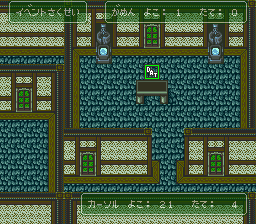
Choose Events イベントさくせい on the map editor's R menu. The map appears with its events marked and a cursor one cell in size; the cursor's place カーソル よこ / たて and the screen's がめん よこ / たて are shown as in the map editor. A on a cell opens its event's page, or a new event's. Positions count cells from 0: 0–63 on a map, 0–255 on the field.
The event editor's R menu has, besides Save, Sample Load, Undo and End:
| Entry | On screen | What it does |
|---|---|---|
| Whole Map | ぜんたいマップ | Shows the map's screens |
| Change Field | フィールドへんこう | On the field: chooses which of the four fields the game uses, フィールド1–4 |
| Dungeon | ダンジョン | On the field: goes to the maps |
| Copy | コピー | Copies an event |
| Delete | さくじょ | Deletes an event |
| Delete All | すべて さくじょ | Deletes every event |
- The field's events can't move. The editor says so (フィールドのイベントはいどうできません, "field events can't move"), and the command picker on the field leaves out the event's own turns and steps, the inn, the shop and the save point. FATE's field events start only by touch, search or automatically.
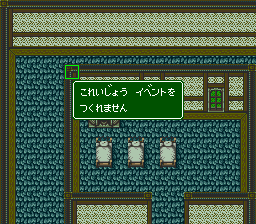
- When the space is full, A on a cell says これいじょう イベントを つくれません ("no more events can be made"). The factory's sample game leaves 7 bytes free, less than an empty event needs, so this is what you meet if you try to add an event to FATE.
Pages and their conditions#
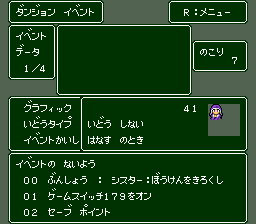 123456789
- 1 Where ダンジョン イベント an event on a map (フィールド イベント on the field)
- 2 R menu R:メニュー Save, Sample Load, Undo, End and the editor's other entries
- 3 Page イベントデータ 1/4 which of the event's four pages is shown
- 4 Conditions じょうけん blank on page 1; on pages 2–4 the item, party, switch and gold the page waits for
- 5 Bytes left のこり of the 17,772 bytes all the game's events share; FATE leaves 7
- 6 Graphic グラフィック a character or an object; here character 41, a sister
- 7 Movement Type いどうタイプ stands still, random, side to side, up and down, approaches, flees
- 8 Start Condition イベントかいし touch, talk, search, automatic, or a key used
- 9 Commands イベントの ないよう the page's commands, numbered from 00
Each event has four pages イベントデータ 1/4 … 4/4. Every page has its own graphic, movement, start and commands, so one event can look and behave quite differently as the story goes on: a guard with something new to say, a chest that is empty once opened, a door that is gone once unlocked.
Pages 2, 3 and 4 have conditions, up to four, and a page counts only when every condition set on it holds:
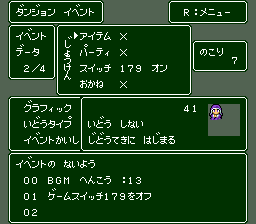
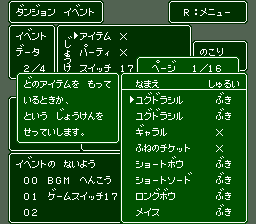
On pages 2–4 the conditions じょうけん stand beside the page number: item アイテム, party パーティ, switch スイッチ and gold おかね, each × when not set.
| Condition | Holds when | FATE uses it |
|---|---|---|
| Item | some hero in the party carries the item, equipped or not | Once: a sailor lets the party board when they carry the ship ticket |
| Party | every hero marked (of the 8) is in the party | Never |
| Switch | the switch is on | On nearly every page with a condition |
| Gold | the party has at least this much gold | Once: the ship ticket's 400 gold |
The highest page whose conditions hold is the one in force: page 4 is tried first, then 3, then 2, and page 1, which has no conditions, is used when none of them holds. A switch turned on in one event can change every other event at once.
An event needn't have a page 1. Several of FATE's scene events have only pages that wait for a switch: they appear when the story needs them.
Movement#
A person's page has one of six Movement Types いどうタイプ. Objects never move, and nothing on the field does.
| Movement Type | On screen | What the person does |
|---|---|---|
| Stands still | いどう しない | Stays where it is |
| Random | ランダム | Wanders a cell at a time, deciding about every 78 frames |
| Side to side | よこに おうふく | Walks back and forth across |
| Up and down | たてに おうふく | Walks back and forth up and down |
| Approaches | しゅじんこうに ちかよる | Walks toward the party's leader, along the longer distance first |
| Flees | しゅじんこうから にげる | Walks away from the leader |
A walking person takes a step of 16 frames and waits about a second between steps. People are stopped by walls as the party is (Walking).
A page has no facing of its own. A person spoken to turns to face the leader, and stays turned, so FATE ends most of its talk pages with event faces down to turn the speaker back.
Start Condition#
The Start Condition イベントかいし decides what sets the page off.
| Start Condition | On screen | The page runs when |
|---|---|---|
| Touch | しゅじんこうと ふれたとき | the leader steps onto the event's cell; on the field, also when the leader walks into it |
| Talk | はなす のとき | the player uses Talk (or X) facing it from the next cell; the event turns to face the leader |
| Search | しらべる のとき | the player uses Search (or X, when nobody answers Talk) standing on it or facing it |
| Automatic | じどうてきに はじまる | at once, by itself, while the page is the one in force |
| Key | かぎを つかったとき | the player uses a key item facing it |
X on the field talks, and searches if nobody answers, so a player can do without the command window for both.
The commands#
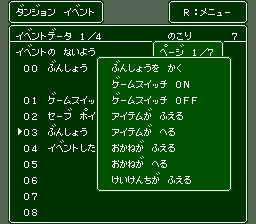
A page's commands run from the top, one after another. A on a line of the list opens a picker of eight commands a page. On a map it has seven pages; on the field six, without the event's own turns and steps, the inn, the shop and the save point. The table gives each command's page on a map, and in brackets on the field.
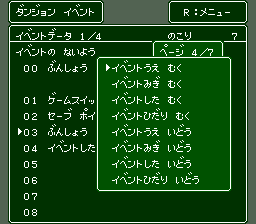
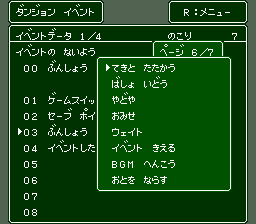
| Page (field) | No. | Command | On screen | What it does | Bytes |
|---|---|---|---|---|---|
| 1 | 1 | Message | ぶんしょうを かく | Shows text in a window, up to four lines of 14 characters, and waits for A or X. The window stays open into a following message, inn, shop, yes / no or save point | 2, + 1 a character, + 1 a line |
| 1 | 2 | Switch on | ゲームスイッチ ON | Turns one of the 200 switches on | 2 |
| 1 | 3 | Switch off | ゲームスイッチ OFF | Turns a switch off | 2 |
| 1 | 4 | Item + | アイテムが ふえる | Gives an item to the first hero with a free place. If every place is full, asks which carried item to throw away for it | 2 |
| 1 | 5 | Item − | アイテムが へる | Takes an item away | 2 |
| 1 | 6 | Gold + | おかねが ふえる | Adds gold | 4 |
| 1 | 7 | Gold − | おかねが へる | Takes gold | 4 |
| 1 | 16 | Experience + | けいけんちが ふえる | Adds experience to each hero in the party. No level is gained until the next battle | 4 |
| 2 | 8 | HP + | しゅじんこうのHPふえる | Restores the heroes' HP by an amount (FATE's 9,999 is a full heal) | 3 |
| 2 | 9 | HP − | しゅじんこうのHPへる | Takes HP from the heroes | 3 |
| 2 | 10 | MP + | しゅじんこうのMPふえる | Restores the heroes' MP | 3 |
| 2 | 11 | MP − | しゅじんこうのMPへる | Takes MP from the heroes | 3 |
| 2 | 12 | Poison | しゅじんこうに どくをかける | Poisons the heroes | 1 |
| 2 | 13 | Paralyse | しゅじんこうを マヒ | Paralyses the heroes | 1 |
| 2 | 14 | Hero joins | しゅじんこうを くわえる | A hero joins the party | 2 |
| 2 | 15 | Hero leaves | しゅじんこうを はずす | A hero leaves the party | 2 |
| 3 | 27–30 | Hero faces up, right, down, left | しゅじんこう うえ / みぎ / した / ひだり むく | Turns the party's leader | 1 |
| 3 | 31–34 | Hero steps up, right, down, left | しゅじんこう うえ / みぎ / した / ひだり いどう | Walks the party one cell, as if the player had pressed the pad | 1 |
| 4 (not on the field) | 19–22 | Event faces up, right, down, left | イベントうえ / みぎ / した / ひだり むく | Turns the event itself | 1 |
| 4 (not on the field) | 23–26 | Event steps up, right, down, left | イベントうえ / みぎ / した / ひだり いどう | Walks the event itself one cell | 1 |
| 5 (4) | 37 | Flash | がめん フラッシュ | Flashes the screen | 1 |
| 5 (4) | 38 | Brighter | がめん あかるくする | Brightens the screen | 1 |
| 5 (4) | 39 | Darker | がめん くらくする | Darkens the screen | 1 |
| 5 (4) | 40 | Red | がめん あかくする | Tints the screen red | 1 |
| 5 (4) | 41 | Blue | がめん あおくする | Tints the screen blue | 1 |
| 5 (4) | 42 | Monochrome | がめん モノクロにする | Turns the screen black and white | 1 |
| 5 (4) | 43 | Normal | がめん もとにもどす | Puts the screen's colours back | 1 |
| 5 (4) | 44 | Shake | がめん ゆらす | Shakes the screen | 1 |
| 6 (5) | 17 | Battle | てきと たたかう | Fights up to four enemies of one set to the battle slot's music. The party can't run | 5 |
| 6 (5) | 18 | Warp | ばしょ いどう | Moves the party to a cell of a map or of the field. The page goes on there | 4 |
| 6 (not on the field) | 35 | Inn | やどや | An inn at a price of 0–9,999 gold: HP and MP to the full | 3 |
| 6 (not on the field) | 36 | Shop | おみせ | A shop selling up to four items, and buying | 5 |
| 6 (5) | 45 | Wait | ウェイト | Waits, in tenths of a second | 2 |
| 6 (5) | 46 | Vanish | イベント きえる | Takes the event off the map | 1 |
| 6 (5) | 47 | BGM | BGM へんこう | Plays one of the 31 songs (0 stops the music) | 2 |
| 6 (5) | 48 | Sound | おとを ならす | Plays one of the 60 effects | 2 |
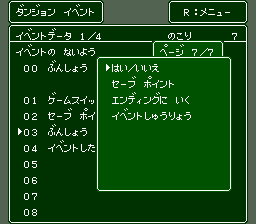
| 7 (5) | 49, 50 | Yes / no | はい/いいえ | Asks yes or no about the message above it; the page splits into a yes branch and a no branch | 1 a marker |
| 7 (not on the field) | 51 | Save point | セーブ ポイント | Opens the save window, ファイル1–3 | 1 |
| 7 (5) | 52 | Ending | エンディングに いく | Fades out and runs the ending; nothing is saved | 1 |
| 7 (6) | 0 | End of event | イベントしゅうりょう | Ends the page here | 1 |
No. is the number the game stores for each command; it follows the editor's own list of their names, which groups them differently from the picker (How it works). The 53 commands are, one for one, the first 53 of RPG Tsukuru 2. Commands that take no time (a switch, an item, gold) run together in an instant; a message, a step, a wait or a flash holds the page until it is done.
Messages and choices#
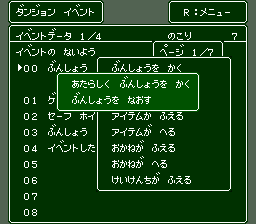
A message ぶんしょうを かく is typed on the editor's keyboard, a line at a time. A on a message already in the list offers a new message あたらしく ぶんしょうを かく or editing this one ぶんしょうを なおす. The window holds four lines of 14 characters, FATE's longest; a long speech is a run of messages, one window at a time. A ▼ blinks at the end, and A or X goes on. The window stays open when the next command is another message, an inn, a shop, a yes / no or a save point, so a question and its answer read as one conversation.
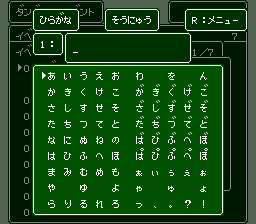 123456
- 1 Page ひらがな hiragana, katakana or other (digits, A–Z, marks and the 16 kanji); X turns the page
- 2 Insert / Overwrite そうにゅう whether a character is put in or written over
- 3 R menu R:メニュー the keyboard's menu
- 4 Line 1: the line being written
- 5 Text the line so far
- 6 Characters the page's characters
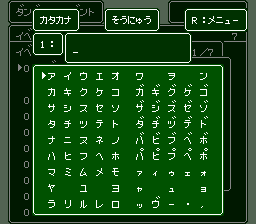
The keyboard has three pages, turned with X: Hiragana ひらがな, Katakana カタカナ and Other そのた (the digits, A–Z, marks and the 16 kanji: 姫 王 城 塔 戦 死 黒 法 攻 撃 神 剣 街 魔 士 聖). Insert / Overwrite そうにゅう / うわがき switches between putting characters in and writing over them. More on the keyboard in Getting started.
A choice はい/いいえ goes straight after the message that asks the question. The page then holds a yes marker and a no marker (…… はい …… and …… いいえ ……): the commands between them run if the player says yes, the commands after the no run if the player says no. The yes branch ends at the no marker, and the no branch at the end of the page, so nothing can follow both: anything that must happen either way goes into both branches. Choices can be put inside a branch.
Switches#
There are 200 switches, numbered 0–199, each on or off, and no variables. Switch 0 is on from the start of every new game. A switch does nothing by itself; it matters only because pages wait for it. The usual pattern is a chain: an event's last command turns a switch on, and the next event in the story has a page that waits for it. FATE uses 72 of them.
Items, gold and experience#
Item + gives the item to the first hero with a free place in their ten. If every hero's places are full, the game says so, asks which carried item to throw away, and puts the new one in its place. Item − takes one away; gold + and gold − add and take gold.
Experience + adds the amount to every hero in the party, but no level is gained there: levels come only at the end of a battle, so the heroes level up after their next fight.
The party#
HP + and MP + restore the heroes by an amount; FATE gives 9,999 for a full heal, by a bed or a spring. HP −, MP −, poison and paralyse do the opposite; FATE uses none of them.
Hero joins and hero leaves change the party. FATE does this 74 times: companions come and go with the story, and a hero is taken out for a duel or a scene and put back after it. Hero faces and hero steps turn and walk the party's leader as if the player had pressed the pad; FATE uses a step after most warps, to move the party off the cell it lands on.
Warps#
A warp ばしょ いどう moves the party to a cell of the field or of any map. The page carries on after the warp, on the new map: FATE's gates warp, then play the town's song, step the party in and show the place's name. Maps are joined only this way (Connecting maps). No command gives the party the ship or the airship; they stand where the start puts them.
Battles#
Battle てきと たたかう fights a fixed group of up to four enemies. The first enemy chosen decides the set (the field's, the dungeons' or the 16 event enemies, which only events call), and the group comes out in number order with no enemy twice: a battle of 3, 3 and 1 fights 1 and 3. It plays the start's battle music; the background is the place's (Battle backgrounds).
The party can't run from an event battle. A win goes on with the page, so the reward and the switch that moves the story on follow the battle command; a defeat is game over, as in any battle.
Shops, inns and the save point#
These three work only on a map.
- An inn やどや names its price (0–9,999 gold) and, if the party stays, fades the music, plays its tune and fills every hero's HP and MP. It cures neither poison nor paralysis, and a dead hero stays dead. Afterwards the area's music comes back.
- A shop おみせ sells up to four items, one per purchase, to the hero the player picks, and buys anything that can be sold for half its price (Shops).
- A save point セーブ ポイント opens the save window, ファイル1–3. On a map it is the only way to save: the field menu's Record works only on the field, on foot (Saving).
The event itself#
On a map, event faces and event steps turn and walk the event (a person) a cell. Vanish イベント きえる takes the event off the map. To make something go for good, FATE gives it a last page on a switch with a blank graphic and no commands.
The screen, waiting and sound#
Flash and shake jolt the screen for a moment. Brighter, darker, red, blue and monochrome change its colours until normal がめん もとにもどす puts them back; a scene that darkens the screen should end with normal, as FATE's do. Wait ウェイト pauses the page for a time in tenths of a second.
BGM plays one of the 31 songs, and sound one of the 60 effects (Music and sound); BGM 0 stops the music. A map's music comes from the start's slots by the map's kind (The music slots): FATE leaves its town slot empty and plays song 13 from each town's gate instead.
The ending and the end#
Ending エンディングに いく fades out and plays the ending: nine cards over the nine battle backgrounds, each with a line of Super Dante's staff, and the game's own author line from Title Settings as SCENARIO. It takes no song of its own. It returns to the opening demo, and nothing is saved (The ending).
End of event イベントしゅうりょう stops the page where it stands; the commands after it don't run. A page with no end simply stops after its last command.
Costs and limits#
All of a game's events, the field's included, share 17,772 bytes. The page shows what is left のこり.
| What | Bytes |
|---|---|
| An event on the field, before its pages | 4 |
| An event on a map, before its pages | 5 (it names its map) |
| Page 1 | 4 |
| Each of pages 2–4 | 10 (its conditions included) |
| Each command | 1 to 5, as the commands table gives |
| A message | 2, + 1 a character, + 1 a line: a full four lines of 14 costs 62 |
| Every event of the game, together | 17,772 |
So an inn (an invisible event with an inn and a BGM command) costs 14 bytes, a staircase 16, a treasure chest about 41, and FATE's largest event, a scene with ヴァンネス, 511.
FATE fills the space: 7 bytes are left, not enough for one more event. Load it into the editors to study, or play with it; to make your own game, start from an empty one (Delete All). The full list of limits is in Limits.
How FATE does it#
The sample game FATE is the best pattern book there is (The sample game): 426 events over 41 maps and the field. Here are seven of its common pieces, read from its events. Load the sample into the event editor to look at them.
Doors, stairs and ways out#
- A castle gate on the field (アスガル城) is an object with a castle graphic, start touch: a warp onto the bottom row of the castle's map, hero steps up off it, and a message with the castle's name, shown on arrival. The town gates do the same, with a BGM after the warp.
- The way out is four invisible objects along the castle map's bottom row, touch, each with a warp onto the field beside the castle and a hero steps down away from it.
- A staircase is an object with a stairs graphic, touch: a sound (effect 42, ), a warp onto the matching staircase on the other floor, and a hero step off it. Each pair of stairs is two such events, each warping to the other; the step off keeps the party from landing on the way back.
A hidden cave#
On the field, a mountainside hides a cave in three pages:
- Page 1: graphic 0, start search. Switch on 199. Another event two cells away, also searched, says やまのほうからかぜが…。 ("a wind from the mountains…").
- Page 2, switch 199, automatic, the cave's graphic: a sound, the message こんなところにどうくつが…! ("a cave in a place like this…!"), switch off 199, switch on 19.
- Page 3, switch 19, touch, the cave's graphic: a warp into the cave (map 20, グニパヘリル), a step in, and its name.
Until the player searches, nothing shows; afterwards the cave stands on the field for good.
Shops, inns and save points#
- A shop: in ヴァルハラ, an invisible object, start talk, with a message (どうぐはいかが?, "any items?") and a shop of the items for sale. Where a shopkeeper is drawn, as in ドヴェルク, they are a person event of their own with no commands, two cells behind the shop's trigger.
- An inn: ヴァルハラ's inn is an invisible object, talk, with inn at 10 gold and BGM 13: the inn hands back to the town's music, which in FATE is silence, so the song is played again. 14 bytes.
- A free rest: an object in アスガル castle, touch. A message asks whether to rest (やすみますか?); on yes: HP + 9,999, MP + 9,999 and a save point.
- A save point: in ヴァルハラ, a sister (a person, talk) offers to record the adventure (ぼうけんをきろくしてあげましょう。), turns on switch 179, runs save point, wishes the party well and faces down again. Her page 2, on switch 179 and automatic, plays the town's song again and turns the switch off. That is the page in the annotated shot.
A treasure chest#
A chest is an object with two pages:
- Page 1: a closed chest, start search. Sound effect 56 (), a message saying what was found (ようせいのリボンをてにいれた, "got the fairy's ribbon"), item +, and switch on 127.
- Page 2, condition switch 127: an open chest, start search, no commands.
Opening it turns on the switch, which makes page 2 the page in force: the chest shows open, and searching it again gives nothing. Every chest needs its own switch; FATE's use 120–136.
A boss#
In the cellar of ミズガル castle, the monster that sacked it is one event, a person with three pages:
- Page 1: start talk. ライネス: コイツが、この城をおそったのか! ("So this is what attacked the castle!"), then battle (an event enemy), then switch on 199.
- Page 2, switch 199, automatic: a sound, ライネス's line about the next castle, switch on 3 (the story's), switch off 199.
- Page 3, switch 3: a blank graphic and no commands. The monster is gone for good.
The battle sits in the middle of a talk page: lose it and the game is over; win it and the page goes on. Page 2 runs once, because it turns off the switch that chose it, and leaves switch 3 on for page 3 and the rest of the story.
Fighting with a different party#
The captain of アスガル's guard offers a sparring match. On yes, hero leaves takes one companion out, battle fights the captain, and hero joins puts the companion back; then まいった! ("I give up!") and switch on 2, which gives the captain a new page with a new line. The same trick, in reverse, has heroes join for the battle against ヨルムンガンド and leave again after it.
A ship ticket: a page on gold, a page on an item#
In ギムレー, a ship's boss sells passage for 400 gold. His event, a person, has three pages, all talk:
- Page 1: the offer and a choice. Yes: かねがたらねーぜ。 ("you're short of money"). No: never mind.
- Page 2, condition gold 400: the same offer. Yes: gold − 400, a sound, item + the ship ticket, switch on 12.
- Page 3, switch 12: nothing more to say.
Page 2 needs only the gold, so it outranks page 1 the moment the party can pay: the same question has two answers with no test in the commands. A sailor then has a page on the item condition, the ticket: どうぞ。 ("go ahead"), event steps down out of the way, switch on 17. And on the field beside ギムレー, a touch event turns the party back with a hero step until switch 17 gives it an empty page.
Fan-made reference material, one of the Eschaton Games Tsukuru guides. Not affiliated with the publishers of the titles it covers. Corrections and questions: contact@eschaton.games.