Behind the scenes#
Who made Super Dante, the line it belongs to, what the developers left in the cartridge besides the program, the second-hand cartridge this study worked from, and how the study behind this guide was done.
The credits#
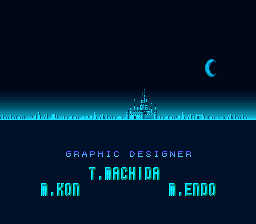
The cartridge names its makers twice. The opening demo scrolls the staff under a castle and a moon, and carries the copyright lines © 1995 ASCII CORPORATION and © 1995 空想科学 (Kuusou Kagaku). The ending of every game shows nine cards, each over one of the nine battle backgrounds, with two lines of small text:
| Card | Heading | Name |
|---|---|---|
| 1 | ORIGINAL | N.YAMASHITA |
| 2 | SCENARIO | The game's own name line, from Title Settings |
| 3 | GRAPHIC | T.MACHIDA, M.KON |
| 4 | PROGRAM | T.SUZUKI |
| 5 | SOUND | S.ISODA |
| 6 | SUBDIRECTOR | D.TAKAMI |
| 7 | DIRECTOR | Y.AOYAMA |
| 8 | SUPERVISOR | T.YOSHINARI, K.FUCHIGAMI |
| 9 | PRODUCER | A.KAWAMURA |
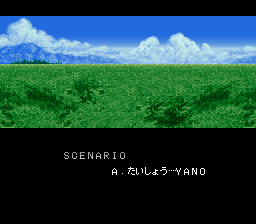
The second card is the game's own: the name line from Title Settings タイトルのせってい, so every game made with Super Dante credits its author as SCENARIO among the program's staff. After the ninth card the screen fades and the opening demo returns, with its copyright lines. There is no THE END and no title card; the whole ending runs about 6,550 frames, a little under two minutes (Playing a game).
One name also sits in the ROM where no one sees it. The sound module's last bytes read ApuDrv v1.0 (C) 1994 S.Isoda: the sound driver's name, its version and its author, the same S.ISODA as the SOUND card.
The developer and the line#
Super Dante was published by ASCII. According to public sources it came out on 31 March 1995, an 8-megabit cartridge at ¥9,800, the first RPG Tsukuru on a console; the same sources name the developer as Kuusou Kagaku, and some listings add Success, for a part none of them states. The cartridge is SHVC-ARDJ; its header calls it DANTE SFC.
Kuusou Kagaku 空想科学 ("fantasy science") left its name inside the program too. Just below the cartridge header sits the text KUSOU KAGAKU DEVELOPMENT SYSTEM VER 2.21, the name and version of the studio's own development system. RPG Tsukuru 2 carries the same tag at the same place, at version 2.28, and an older screen left in Super Dante's ROM shows version 2.18 (below). So the two cartridges were built with successive versions of one tool chain, and on the PlayStation Kuusou Kagaku's logo film opens RPG Tsukuru 3. The line Super Dante → RT2 → RT3 is one studio's work (Compared with RT2).
What Super Dante and RT2 share#
Compared byte for byte, the two ROMs share 412 runs of 32 bytes or more, about 47 KB: the start-up code at the very same addresses, the core library a few bytes away, and a good part of what runs the events, the text, the windows and the battle. The rest of RT2 is new code on the same design.
| In both cartridges | Only in Super Dante | Only in RT2 |
|---|---|---|
| The start-up and interrupt code, at the same addresses; the warm-boot check on the tag | The save check (one sum, the boundary copy, the message) | The save check (nine sums) |
| The core library: DMA, multiply and divide, the random numbers, the decompressor, the objects | The part codec that packs the map parts | A tile packer, its second graphics decompressor |
| Windows, cursors, sprites and the script machine | The editors | The editors, and a mode of their own |
| The event interpreter's step and the move-script runner | Most of the command handlers, written around Super Dante's operands | 22 more commands |
| Text drawing | One 8 × 8 font, reached through a table | A kanji page and two 8 × 8 fonts |
| The mode 7 view and its 16 KB of perspective tables | The mode 7 field | The air view alone in mode 7 |
| Pieces of the battle: the setup, the turn code, escape, game over, the shake tables | The encounter check and its fixed curve | Encounter rates per area |
| The Turbo File STF library (Super Dante's the earlier build) | — | Multi-unit Twins; the memory pack |
| The sound driver's pitch table (768 bytes) | Its own sound driver | A rewritten driver on the same formats |
| The development tag (version 2.21 and 2.28) | A debug box on the Turbo File pages | A test page in the factory save |
Before the cartridge: Dante on the PC#
The name comes from ASCII's Dante, an RPG construction tool for the MSX2 (1990), and RPGツクール Dante98 for the PC-9801 (1992), the first product called RPG Tsukuru. According to public sources, Dante98's published limits are 200 switches, 8 heroes in a party of 4, 128 items and 32 spells, with event conditions on an item, a party member, a switch and gold: exactly Super Dante's numbers. So the cartridge reads as Dante98's design on the Super Famicom. None of the PC programs was examined here; the line is set out on Compared with RT2.
The factory save and the sample game#
A whole battery image sits in the ROM: exactly what the cartridge's save memory holds, with three play saves and a complete game, the sample FATE (The sample game). Playing the Sample Game runs it straight from the ROM, whatever the editors hold, and each editor's Sample Load サンプルロード copies its part from there. It is not a safety net: a save that fails the power-on check is erased to an empty project, never restored from the factory image (The save and the Turbo File).
FATE is a Norse-myth fantasy played straight: ライネス sets out with a holy sword, guided by the world tree, through the castles アスガル, ミズガル and ウドガル, and at the end learns that the man in black, ヴァンネス, is his older brother. Its Title Settings name line reads A.たいしょう…YANO. It has no tutorial and no word about the product, unlike RT2's sample, a school comedy that teaches the manual and ends by advertising RT3. According to public sources (one fan wiki, not checked), FATE was ported from a Dante98 game, Fate ~The ancient relation~, its events cut to fit the cartridge.
Two small slips are left in its events. Switch 25 is set when the ship ビフレスト arrives and never tested; switch 181 is tested by a door on map 25 and never set, so that door never hides. It looks like a slip for one of its neighbours in the pattern the other doors follow.
Hidden content#
The development tag and the reset#
The studio's tag below the header has a second job, as in RT2. At start-up the program compares it with a copy in the console's working memory. After power-on there is no copy: the program writes one and shows the logos before the opening demo. After the console's Reset button, which leaves the working memory as it was, the copy is found and the program goes straight to the opening demo. That is read from the code; unlike RT2's, it was not run.
L + R + START + SELECT returns to the title menu from any game, test play included, without the save check (Getting started). It is no secret: RT2 has the same, and its manual says so.
A debug box on the Turbo File pages#
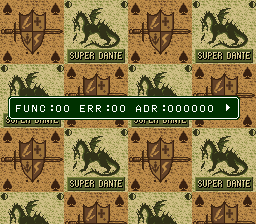
The one hidden feature a player could meet. After every step of the Turbo File pages the program can open a one-line box, FUNC: ERR: ADR:, with the Turbo File library's function number, its result and an address, and wait for a button. It is a debug readout, switched by a flag the developers presumably set by hand. But that flag is the very byte in which the power-on check records that it erased the save. So after a power-on that lost the save, every Turbo File step stops on the box until a game is started: a player who has just lost a game and reaches for the Twin to restore it meets it every time.
It was seen in MesenCE, the emulator with a Turbo File Twin, from the second-hand cartridge's own failing save (below). It does no harm: a button press at each box, and the pages work (The save and the Turbo File). These boxes are the only place the program's hexadecimal print is used. RT2's scripts never use theirs, so RT2 has no such box.
An older build's debug monitor#
Bank $80, the core of the program, holds 12 KB the final program never runs. In its last part sit screens of an older build, written for an older font: they print plain ASCII, which Super Dante's text code is not.
- A development boot screen:
KUSOU KAGAKU DEVELOP SYSTEMandVER 2.18, older than the cartridge's 2.21, with a line of test characters. It fades in, waits half a second and fades out, as the logos do. - A crash handler: it stops everything, blanks the screen, keeps the address it came from, and enters a mode that the final program leaves unused: the old build's error mode.
- An error screen that prints
ERROR,ADRSand a dump of the script machine's state:P(X,Y),OFFSET,KEY,VRAMadrs,VRAMbuf,stepcnt,CTRL,STAT,proadrs,readadrs,size,code-SP,data-SP,PC,CMD. That is a debugger's crash screen for errors in the window scripts.
Nothing in the final program reaches any of it. The Cutting Room Floor's page on the game reports these screens, and it was that page, read through a site that quotes it, that pointed this study at them: the study's own search for leftover text had looked only for the game's text code, not for ASCII. The final build replaced the monitor with nothing; the Turbo File box above is the only debug display left in reach.
Scripts of an earlier build#
Two stretches of the ROM hold window scripts that nothing reaches, linked against an older layout of the program: their calls point at addresses that now hold data. They are stale bytes the build left in place.
- An older field menu, with equipment, Give and Discard, the status page and a command the final game doesn't have: のりおり (board / leave), with the messages のっている and のっていない ("aboard", "not aboard"). In the final game a vehicle is boarded by walking onto it. A board-and-leave command was planned and dropped.
- The old build's table of windows, and old field scripts with test windows ("1 2 3 4 5 6 7 8", "HO", "MO").
What isn't there#
- No debug menu. Every mode the main loop can enter is accounted for; the unused ones are never set by live code. There is one routine that reads the controller (RT2 has two), and no button code beyond the return to the title and test play's B.
- Ten songs nothing plays. Of the 31, songs 5, 10, 12, 14, 16, 18, 21, 24, 26 and 30 are played by no part of the program this study reached and by no event of FATE. They may belong to editor screens not visited (Music and sound).
- A second kind of Turbo File file, letter
Cbeside the files'N, is in the program's table but leads nowhere. Nothing says what it would have held. - Bugs: a magic item used on the field heals by the wrong spell, the inn takes its price from part of the gold, auto battle picks the wrong attack spell, a heal-all spell can read a stale figure, and a few smaller ones (Limits, bugs and workarounds).
The second-hand cartridge#
The study had Super Dante's ROM and the save of one second-hand cartridge, a previous owner's work. Its maker is not named anywhere in this guide; what follows describes what is on it.
The damage#
The save failed Super Dante's own power-on check. Its one checksum was off by 182, so the first time the cartridge was switched on in a console, the title would erase everything on it. The stored figures agreed with one another: the game had written the save whole, and something had changed it since.
The contacts were cleaned and the save dumped three more times. All three dumps came back identical to the first, byte for byte, and failed the same way. So this was not a bad read, as it had been with one of RT2's cartridges (RT2's misread dump): the change was in the cartridge's memory itself. There was no good dump to be had.
Once the layout of the save was known, the change was found: six single bits set, each in a field the cartridge's game leaves empty, adding up to the checksum's error exactly.
| Where | Why it can't be the game's |
|---|---|
| The price of item 0 | Every item of this project is empty; this one alone would cost 16 gold |
| A screen record of the map pool | No screen of the pool is in use |
| The name of map 101 | No map is named or in use, and the bit makes a ▼, which no name can hold |
| The map screens (two bits) | The area is zero but for these bits |
| The event space, past the end of its events | All zero past the events but for this bit |
Cleared, the six bits give back a save that passes the game's check as it was stored, with no checksum rewritten, and in an emulator the game keeps it unchanged. A different set of bits adding to the same error can't be ruled out in principle; a match to the last unit, with every bit in an empty field, makes this the save as the game last wrote it. Bits set rather than cleared, scattered and alone, are what decaying cells look like, and may point to a weak battery.
The cartridge stays off a console. Switched on, it would erase its own save at the title; the dumps keep the data either way, but the cartridge's own copy is the only one of its physical state. Writing the repaired save back, with the dumper or through a Turbo File Twin and the game's own load, is the owner's decision, and nothing has been written to it.
The test project on it#
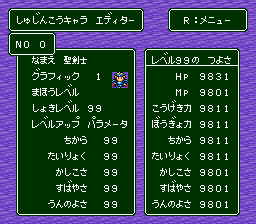
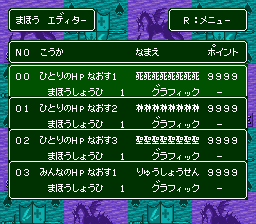
What the cartridge holds is a test project rather than a game:
- No title, no author, no items, no maps. The enemies are the sample's, unchanged, and the start is a new project's.
- Two heroes at level 99 with every growth value 99: hero 0 is named 聖剣士 ("holy swordsman"); the other six are left unnamed at level 1. In the editor 聖剣士's stats come out near 9,800.
- All 32 spells renamed, costing 0 or 1 MP, at power 9,999 but for spells 5–13 (power 0). Some names repeat one kanji eight times; others are words and given names typed in kana.
- 32 events, all on the field: 31 people with a graphic and no commands, and one with a message, 「あかかさた」 (keys pressed on the keyboard), that turns switch 0 on.
- One play save, in the third slot: a game of the sample FATE, its party at levels 13 and 14. The other two are empty.
It reads as a trial of the editors: how strong a hero can be made, what a spell's power does, how an event is placed. As test data it was worth more than its size: a save made by Super Dante's own editors, with a play save and a real fault, beside the factory one.
How this study was done#
Everything in this guide comes from the program itself. There is no manual or guidebook of Super Dante in the project, so the guide cites none; the few facts from public sources (the release, the price, the PC line, FATE's origin) are said as such.
- An emulator run headless. Mesen 2, driven by a script with no window: saved states, scripted button presses, memory watched, traced and dumped, screenshots taken from the emulated screen. Every run worked on a copy of a save.
- A code/data log. The emulator marks each byte of the ROM as code or data as it runs. Runs from power-on and from saved states of every menu, editor and screen marked 74,843 bytes; a disassembler written for the study reads the log, and the routines RT2 shares were named from RT2's study.
- The editor as a probe. To learn what a byte of the save means, one field was changed in Super Dante's own editor on a copy, the save written, and the battery memory compared before and after. Then the code that reads it was found. Every save was finally rebuilt byte for byte from its decoded form, and a save edited by hand was played.
- The game's own code, run outside the game. The map parts are packed by 70 small routines; rather than rewrite them, a little 65816 interpreter runs the cartridge's own decoder. Maps, fields and a battle screen drawn from the data match the emulator pixel for pixel.
- Battles replayed. Every random number a battle drew was recorded where the code drew it, then the battle was replayed turn by turn through a model of the rules written from the code: 517 turns and 76 escape rolls reproduce exactly (How battles work).
- A second emulator. So that nothing rests on one emulator's quirks, ten of those recordings were made again in bsnes, from power-on with the same buttons: 276 turns and 47 escape rolls, the same random numbers at the same places in the same order, and the same result as Mesen's.
- Sound played against the game. Each of the 31 songs and 60 effects was ripped from the ROM alone and played beside the game playing the same number: every change came on the same frame, within one.
- The Turbo File in an emulator that has it: MesenCE, with a Turbo File Twin on the second port. Saving, loading and deleting round-trip byte for byte; no real Twin has been tried yet.
- The pictures and sounds of this guide come from the ROM by the study's tools: the graphics drawn from the game's own data, every song and effect played through the game's own driver, and every screenshot taken by script in bsnes from power-on with the factory save. The Turbo File screens are MesenCE's, and the two of the test project are from its repaired save.
The work ran as thirteen steps, each finished with its notes, a tool and a check:
| Step | What it settled | How it was checked |
|---|---|---|
| D1. The save check | The power-on check, and that the cartridge's save fails it | Every sum of the factory save reproduced; three re-dumps identical |
| D2. The program map | Which of the 1 MB is code; the main loop and its modes; 108 of RT2's routines found | A code/data log from 112 emulator runs over 57 saved states |
| D3. The screens | Every menu and editor page, and what each save holds | Screenshots of each, with saved states to return to |
| D4. Text | The character code, the two fonts, 1,316 strings | The keyboard's own rows and the sample's names decoded |
| D5. The save | Every byte of the 32 KB, the play saves, the six damaged bits | The factory save, the cartridge's and its repair rebuilt byte for byte; a hand-edited save played |
| D6. Events | The event space, the pages, the 53 commands | Every event of both saves parsed to the byte |
| D7. Maps and graphics | The part codec, the four fields, the three map kinds; characters, enemies, backgrounds, magic | Seven views and a battle screen drawn from the data, matching the emulator pixel for pixel |
| D8. Battle | Every rule, formula and bug | 517 turns and 76 escape rolls replayed in Mesen, 276 and 47 in bsnes |
| D9. Play | The field, the command window, shops, inns, saving, encounters, vehicles, test play, the ending | Test saves run in the emulator, an event beside the party running each command |
| D10. Sound | The driver, 31 songs, 60 effects, the instruments and samples | All 91 ripped and played against the game, each change on the same frame within one |
| D11. The Turbo File | The file, the pages, the library | Save, load and delete round-tripped byte for byte in MesenCE |
| D12. Scripts and hidden content | 903 scripts; the debug box; the older build's leftovers; FATE and the cartridge's game | The debug box shown in MesenCE from the cartridge's own failing save |
| D13. The overview | The lineage against RT2 and Kanadeeru; the PC line from public sources; the older build's debug monitor | Every lineage row answered or marked open |
What's left open#
Super Dante counts as decoded: every format a game is made of is read and written back. These points are not settled:
| Still open | Why |
|---|---|
| The warm boot (a reset going straight to the opening demo) | Read from the code; not run |
| What songs 5, 10, 12, 14, 16, 18, 21, 24, 26 and 30 were written for | Nothing reached in the program or the sample plays them; perhaps editor screens not visited |
What the Turbo File's second file kind, C, would have held | No script, string or table says |
| A 13 KB block of data that Kanadeeru's ROM also holds | Neither graphics nor sound samples, and nothing in Super Dante's code points at it |
| Some event commands in play: teleport, keys, giving to a full hero; a battle at sea; the surprise round's effect | Not yet run with test events |
| Why a defending enemy with attack twice was not seen to act twice | The battle script says it would; the recordings never showed it |
| A few bytes of the start settings and the map header | No code read so far uses them |
| The Turbo File's write-protect and low-battery cases, and a real Twin | The emulator sets neither; no real Twin has been tried |
| What sets the cartridge's six bits, and the state of its battery | Only a measurement on the cartridge itself can say |
Fan-made reference material, one of the Eschaton Games Tsukuru guides. Not affiliated with the publishers of the titles it covers. Corrections and questions: contact@eschaton.games.